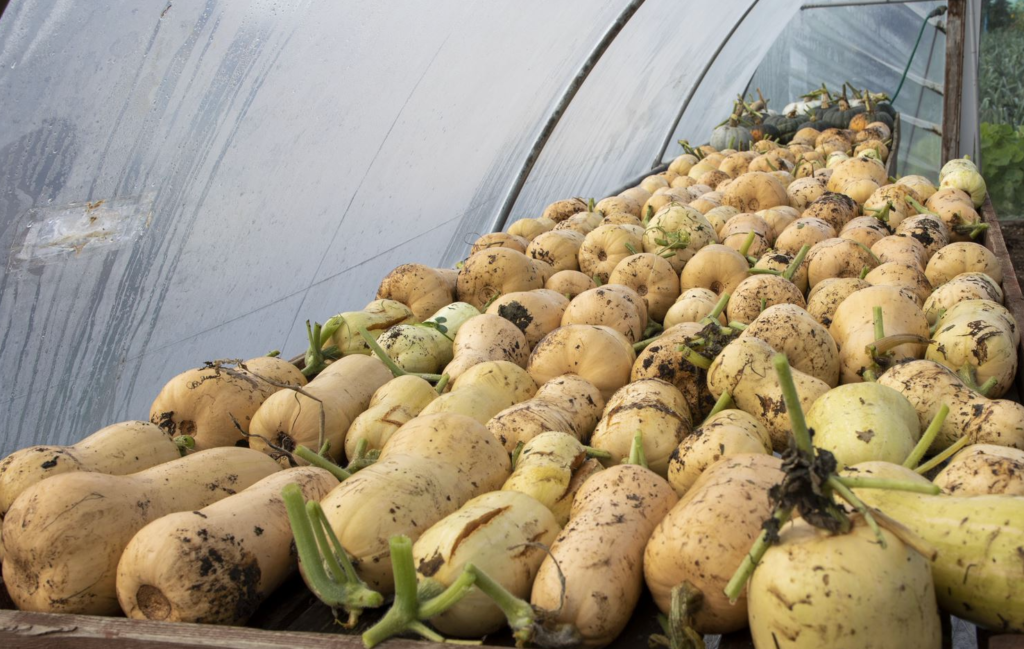
We harvest hundreds of winter squash every year. These squash are nutritious and delicious, good for eating within a couple of weeks or for storing for months. You can roast them, stuff them, puree them, grate them into cakes, and much more. Even the seeds are tasty and they are high in protein and healthy oils. Find out more about this splendid autumn crop.
Don’t squash the plants
We plant each winter squash seedling several metres apart. At the time, it seems incredible that the small plant will need so much space.
But over the growing months, it sprawls across the gaps and the squash start to be visible through the tangle of leaves. Before the autumn frosts hit, we call on as many hands as we can to get all the squash off the plot and safely into storage.
Photo: Steve Grundy
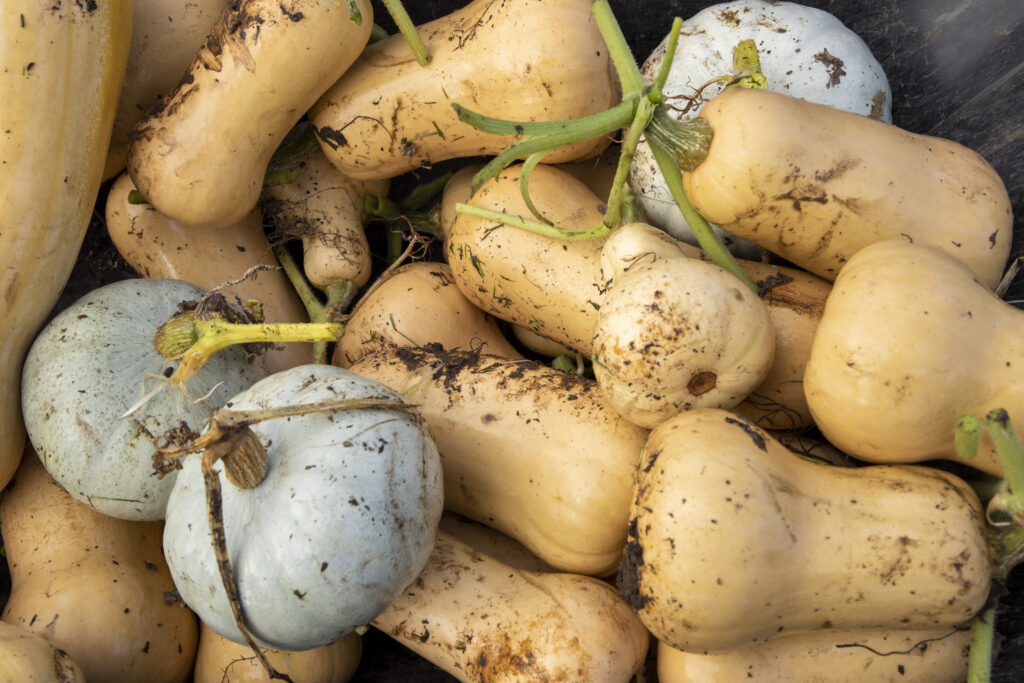
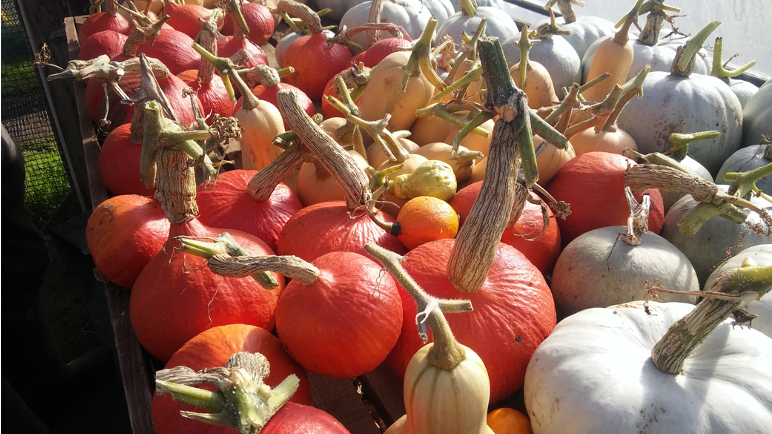
Kabocha, Uchi Kuri and Butternut
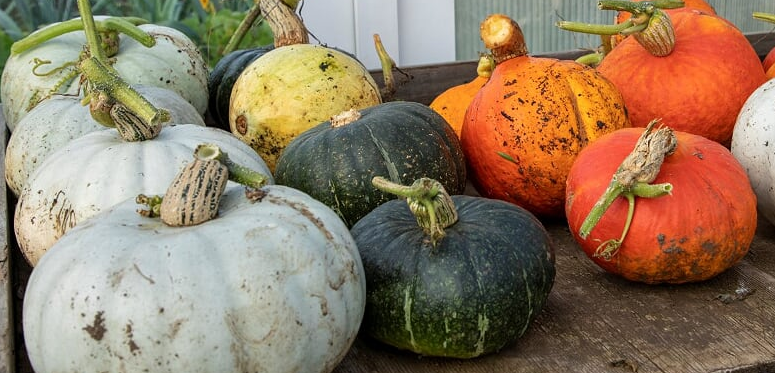
We grew three varieties this year. Usually, we have the superb Crown Prince (the large grey one) but the mice feasted on those. Let’s have a look at the ones that we do have:
Photo: Highbridge Community Farm (Steve Grundy)
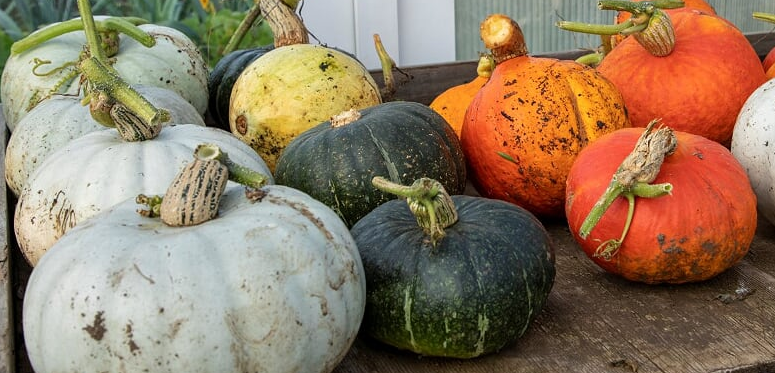
The gloriously-coloured orange one is the Uchi Kuri or Red Onion squash, also known as orange hokkaido. Kuri translates to “chestnut” in Japanese, which indicates the flavour of its golden flesh. It has tender skin that becomes soft on cooking.
The Kabocha (Japanese pumpkin in the USA) has this deep green skin and bright orange flesh. It’s sweeter than butternut and it keeps its shape when cooked which makes it ideal for roasting, steaming or frying.
The butternut is the most recognisable of the three with its distinctive teardrop shape and pale colour. Botanically, the butternut squash is a fruit, specifically a berry.
A peduncle is not a handle
Tempting though it is to see the stalk of a squash as a handy carrying handle … don’t. The stalk – called the peduncle – seals the squash and helps to extend its shelf-life. If you snap off the peduncle, your squash won’t store as well. So, when you carry a squash, cradle it like a baby, support it underneath … any way that works for you. Except carrying it by the peduncle.
Curing the squash
Squash are best a few weeks after they’ve been harvested. Giving them time concentrates their natural sugars and enhances their flavour. Set them in a warm place, such as a sunny window sill, and rotate them periodically. Then store them in a cool, dark, dry place (one Expert Grower uses space under a bed) and they’ll be good through to late Spring.
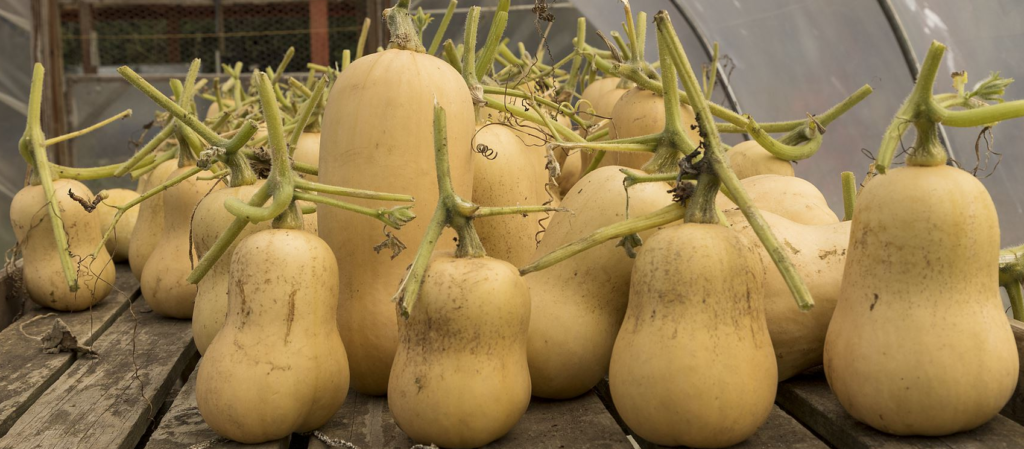
What do you see?
Try this exercise in mindful creativity. Look at the stalk of a squash. Look at its shape. How does it curve and branch? What does it make you think of? A dancer? A wind turbine? A praying mantis? A molecule? Just let your imagination wander for a little while. What comes to your mind?
Photo: Steve Grundy
Do you grow (or enjoy eating) winter squash? Let us know which varieties you’ve grown, your tips, and recipes.
We keep our Farm prices low – but there’s loads out there that costs nothing. Elderberries, rosehips, and blackberries are abundant right now and can be turned into delicious food and health-boosting syrups.
Find them in hedgerows near you or raid our own foraging hedge.All of them can be frozen so seize the season, pick them now, and you’ll be able to use them for months to come.
Rose hips
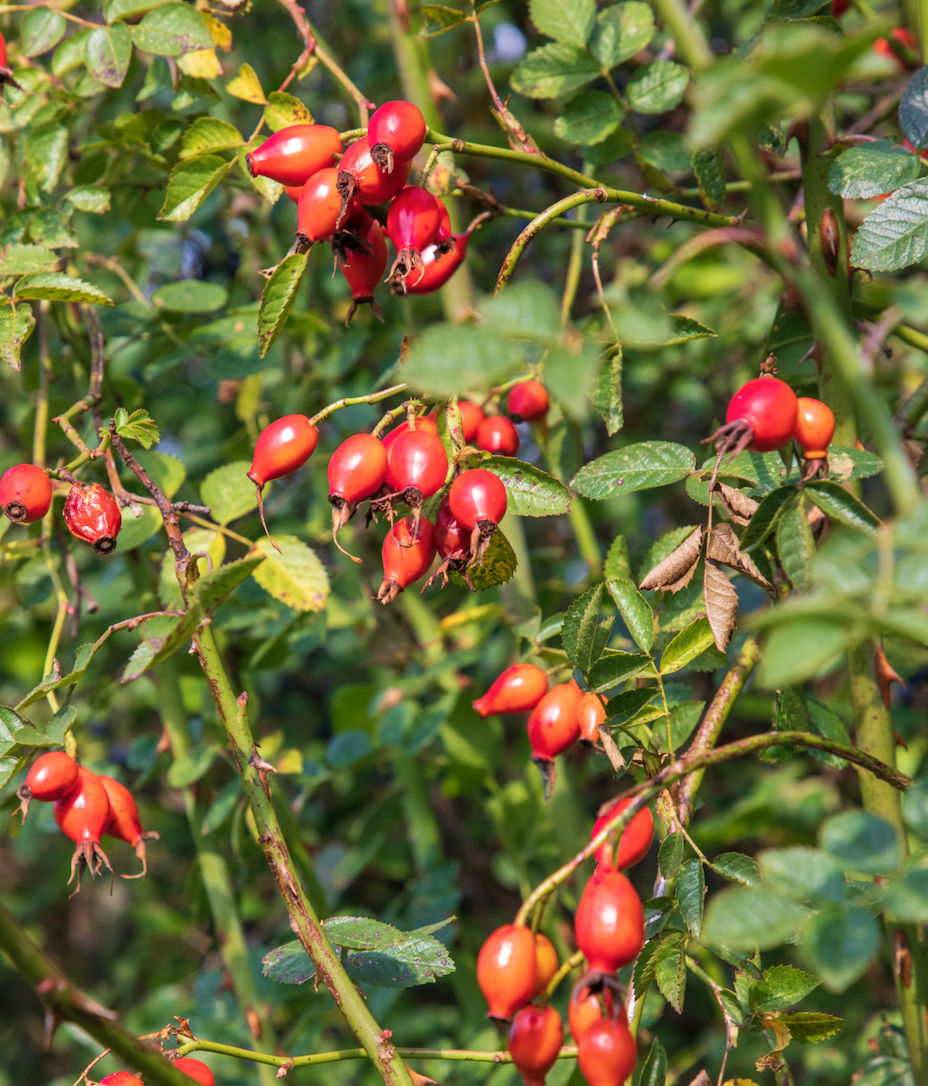
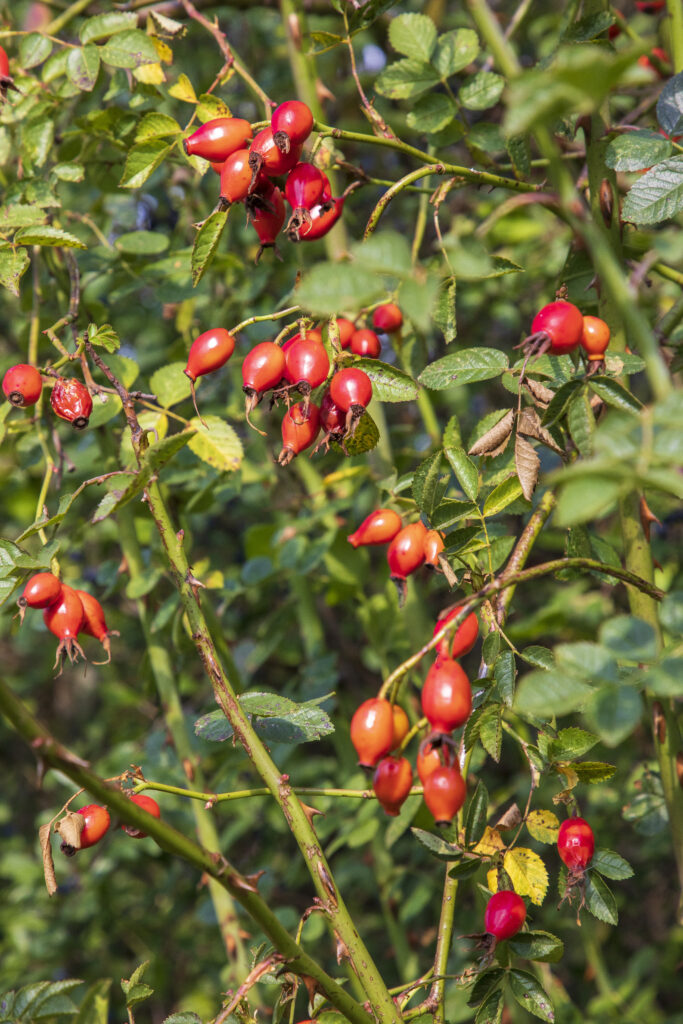
Rose hips are the fruit of the rose plant, rich in antioxidants and vitamin C. Weight for weight, they have more than 20 times the vitamin C of oranges. People have used them as drinks and natural health supplements for centuries.
Rose hips are edible but they contain both rose seeds and tiny hairs – and these hairs irritate our mouths and intestines. As a result, rose hips are normally strained for their juice only.
Pick them when they are completely red, with no visible green. Leave any shrivelled or mushy rose hips on the plant. They won’t be good for our purposes but the birds will still enjoy them. If there’s a light frost, so much the better. It will help to sweeten the rose hips.
Photo: Steve Grundy
Rose hips make palinka, the traditional Hungarian fruit brandy. The best known use is traditional rose hip syrup. Find Kate’s recipe here. You can take a spoonful to boost your vitamin levels (as recommended for a generation of war children by the Ministry of Food) but it’s also delicious drizzled on cake or ice cream or in a rosehip cocktail, such as this Gimlet from the Isle of Wight Distillery. If drinking it isn’t your thing, make yourself a skin-nourishing rosehip oil.
Elderberries
Elderberries are one of the most commonly used medicinal plants in the world, packed with antioxidants. They are poisonous raw so must be cooked or treated to become useable.
Pick the black berries when they are fully ripe, with no or few green berries in the clusters. You need to be quick when you see them. The birds love them and the berries swiftly turn from ripe to overripe. The easiest way to remove the berries from the stalks is to strip them off by using the prongs of a fork. If you can’t use them straight away, you can freeze them and use them later.
Find Kate’s recipe for medicinal elderberry rob (rob is an old word for cordial) here. It’s soothing hot and you can take it neat, diluted with water, or with a tot of something stronger.
Blackberries
This year is giving a bumper blackberry crop: bushes loaded with supersized berries. These purple berries are packed with vitamins, minerals and protective plant compounds called anthocyanins.
Blackberries are the fruit of the bramble. (Bramble specialists are called “batologists”. You’ll thank me for that when you win your next pub quiz!) Each berry is made up of 20-50 single seeds known as drupelets. Technically, they are an ‘aggregate fruit’ rather than a berry.
Pick them when they are fully purple, avoiding any that are squishy, dull in colour or have any evidence of mould. You can eat them raw as well as cooked and they freeze well.
Blackberries are just as versatile as the berries that we buy, such as raspberries, blueberries, and strawberries. Eat them raw with yogurt or cream, in salad, or paired with desserts. Blend them into smoothies or make blackberry cocktails. Bake them into pies and cakes or steep them into oils, vinegar, or alcohol. Blackberries have a high pectin content which makes them ideal for jams and jellies too… So many uses for something that costs nothing.
Find our recipes for blackberry loaf cake and blackberry vinegar. Switch out the pineapple from a traditional pineapple upside down cake for blackberries – delicious!
Our foraging hedge
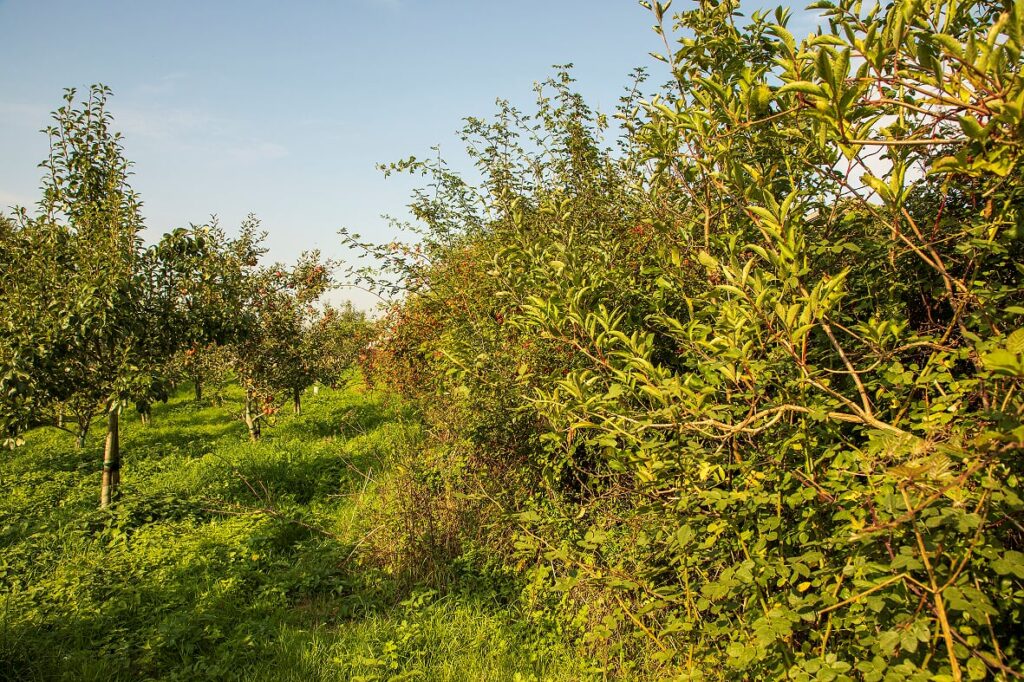
If you haven’t explored it yet, head over to the pond and browse our own foraging hedge. In 2010, the Woodland Trust gave our project several hundred hedgerow trees. We planted these, along with wild flowers and apple trees. We now have a source of berries, sloes, crab apple, hazel nuts and rosehips.
Photo: Steve Grundy
If you’ve got any favourite uses for foraged blackberries, elderberries, or rosehips, please let us know.
Plot 19 have a glut of cucumbers. so it’s a good time to make them into recipes for food and body and savour them for months to come.
Is it a fruit or is it a veg?
Before we go any further, let’s clear this one up. Botanically, a cucumber is classified as a fruit. This is because it contains tiny seeds in the middle and grows from the flower of the cucumber plant. But most of us recognise it as a vegetable.
Cucumbers are a member of the cucurbitaceae family (gourd family) which also includes courgettes, squash, melons, and pumpkins.
Cucumbers in history
The cucumber is one of the most ancient vegetables. It originated in India over 4000 years ago. It was extremely popular in the Roman Empire with Emperor Tiberius (14 – 16 AD) demanding cucumber to eat every day of the year.
Cucumbers arrived in England in 14th century but were not popular. They returned with more success in the mid-17th century. In the US, about the same time, a medical prejudice against uncooked fruit and vegetables meant that the cucumber fell out of favour.
Nowadays, cucumbers are used all around the world.
Growing cucumbers
Cucumbers are a fast-growing crop. They like fertile soil and warm temperatures. They do not tolerate frost. The main care requirement is consistent and generous watering (they need at least an inch of water a week (more, if it’s particularly hot) and they can become bitter if the watering is inconsistent. So, thanks to Team 19 & 20 for their efforts here.
In the UK, cucumber production is concentrated in parts of the North East and South East of England.
Cucumbers for health
Cucumbers are nutritious. They are low in calories and high in fibre and, at 96% water, cucumbers can help keep you hydrated. Cucumbers aren’t a stand out source of vitamins and minerals but they wins with their antioxidant and anti-inflammatory properties.
As well as taking their nourishment internally through food and drink, you can use cucumbers to soothe your skin. Place cucumber slices on your closed eyes to cool the sensitive skin around the eyes and reduce puffiness. Or try this recipe for a cucumber face mask:
Mash up half a cucumber in a blender or with a fork. It’s fine as it is but, to ring the changes, add a tablespoon of natural yogurt or a tablespoon of oats and another of honey.
Spread over your face and neck and leave for 15 mins.
Rinse off with lukewarm water.
Cooking with cucumbers
A raw cucumber lasts about a week in the fridge but you can make the most of a glut by cooking the cucumbers. Try these ideas.
Cucumber ice cubes. Slice cucumber thinly into an ice cube tray before you fill it with water. (You could also add some mint from the HCF Herb Garden.) Use the cucumber ice cubes to add a refreshing flavour to summer drinks.
Find lots more recipes for cucumbers here. Which is your favourite?
Three regular HCF summer crops burst onto our list of available produce this week. Find out more about the broad beans, pattypans, and fenneland let us know if you’ve got a favourite seasonal recipe.
Broad beans
These beans are on Pick Your Own. Their season is short so fill a bag or two now and enjoy them fresh or freeze them for the months to come.
Gently peel the pods away from the stems of the plant. (If you yank them, you risk breaking the stem or even uprooting the plant.)
To prepare them, slit the fat outer pod and run your thumb along the furry inside to pop out the broad beans. You can use them like this but they are even better if you go on to double-pod them – removing the thick skin that encases each individual bean. Blanch the beans for a couple of minutes, let them cool slightly, then remove the outer skin to reveal the tender, bright green bean below. Smaller beans are more faff to pod but they’ll pay you back in sweetness; the bigger beans can get mealy over time.
Broad beans are a good source of protein and vitamins A & B and super versatile. You can eat them in salads, crushed into dips, stirred into risotto or summer casseroles… You’ll find dozens of recipes online; here are a couple to get you started:
Every part of this plant is edible, from the thick, crisp bulb to the feathery leaves. It has a fresh anise flavour – very present if you eat it raw, fading to a mellow backnote if it’s cooked. To have fennel through the winter, blanch and freeze it. It won’t keep the crisp texture of fresh raw fennel but it’ll do just fine in a cooked meal. Fennel is high in fibre, potassium and vitamin C.
Simply slice raw fennel into salads or prepare slices or chunks for cooking. You can grill it, fry it, roast it, blend it into soups … try these ideas:
These odd-looking vegetables are summer squash. Their scalloped edge and slightly flattened shape get them comparisons to flying saucers or flattened brioche.
Their taste is similar to courgettes, perhaps a little sweeter. Unlike their winter cousins, you don’t need to peel them – eat the skin as you would with a grilled or roasted pepper. They are super versatile, working well grilled, stuffed and baked, and roasted.
Pattypans are loaded with fibre and a great source of vitamins A and C. Here are a couple of ideas:
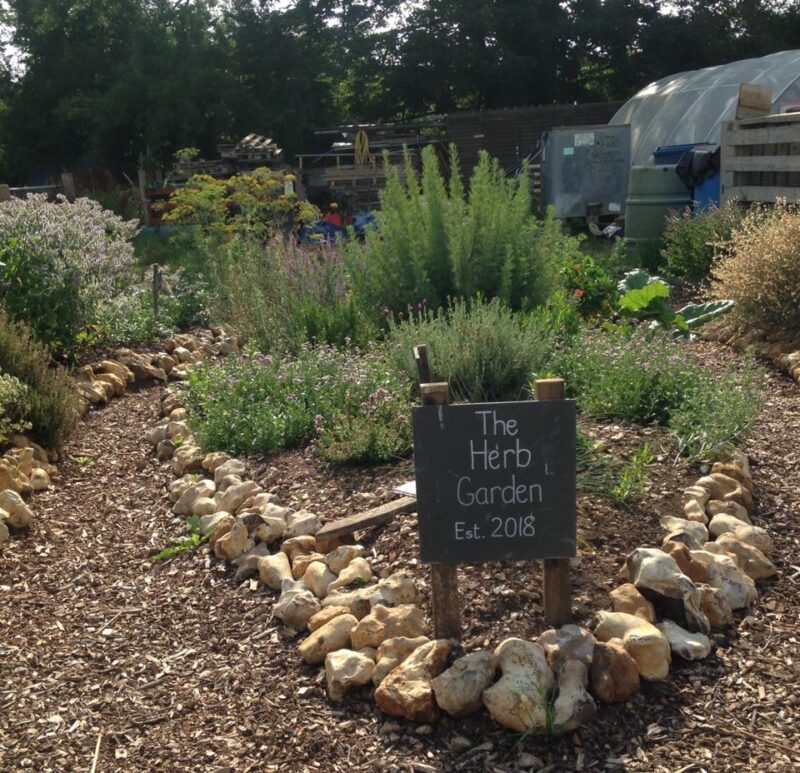
Our herb garden is flourishing. As well as favourites like rosemary, thyme, and chives, we grow some less well-known herbs. These are hard to find in shops so it’s well worth picking some to try next time you’re at the farm.
Photo: Highbridge Community Farm (Steve Grundy)
Sweet cicely
This herb was used to sweeten food long before sugar came to the UK and is still useful today to reduce the sugar needed with tart fruit. Worth a try with the last of this season’s rhubarb…
Sweet cicely has soft, ferny leaves and white umbrella of flowers, looking a bit like cow parsley. Add the leaves to raw or cooked dishes.
Lovage has been valued for its medicinal and culinary properties since ancient times. As well as vitamins, it contains anti-inflammatory and anti-oxidant properties.
The leaves look a little like flat-leaf parsley. The whole plant is edible, offering a mild celery-like flavour. (In Italy, it’s often referred to as “mountain celery”.) The green leaves are very good chopped into salads or lightly cooked summer veg. Steam the stems – the flavour mellows in cooking.
This tender herb is more widely available in the UK – but it will typically be imported. Also known as true tarragon, it’s one of the four “fines herbes” in traditional French cooking, offering a sweet anise flavour. Tarragon is particularly suitable with fish, chicken and eggs.
Beware of the imposter, Russian tarragon. It looks similar but doesn’t bring the tingly aniseed taste to the tongue.
Wild Hive Ecological Educational Collectivegets our local schools and neighbourhoods growing. Founder Jo Hutchison shares how they’re doing this.
Find the story of Wild Hive here. Discover here how Wild Hive is helping to grow a new HCF team: GreenTeam@HCF.
Permaculture design for people & place
We were very lucky to have been joined at the start of our journey by Liz Darley (Grow South Permaculture), who brought Permaculture principles to life for our expanding network at various local educational and community garden sites, including The Outdoor Wildlife Lodge at Otterbourne School, ‘The Hive’ (College House) in Compton (then Eastleigh College’s site), and Youth Options’ Outdoor Learning Centre in Bishopstoke.
Our projects and approach have been greatly informed by Children in Permaculture, and we continue to be helped and encouraged by that team and the network of practitioners and educators from The Permaculture Association.
Last year, we trialled a bespoke, condensed Practical Permaculture Intro mini-course with Eastleigh College’s Functional Skills/Enterprise students. We also realised the benefits of offering one-off Practical Permaculture Design Tasters, helping to draw active participants together at sites that are ripe for renovation.
‘Growing to School’ pilot
With the support from four local Primary Schools, in Spring 2022 we launched our ‘Growing to School’ pilot project, which involved:
Creating 250 Little Local Grow Kits (Spring: Potatoes & Pollinators) for children to grow at home with the support of our online community (raising £550 for Save the Children’s Ukraine fund);
Developing Local Grow Packs to make immediate use of the existing beds and growing spaces in schools;
Trialling the formation of Green Teams of children and parents/carers to support growing activities; and,
Running some in-class Children in Permaculture-style growing sessions to enable more children to have the opportunity to ‘grow a meal’ and be part of the perpetual growing cycle.
Changemakers at The Point (Eastleigh’s new Sustainability Hub)
Autumn 2022 marked the start of our Changemaker residency at The Point – as part of Eastleigh’s new Sustainability Hub. This was the prompt we needed to register as a Community Interest Company in order for our enterprise to become sustainable itself.
With a little seed funding from The National Lottery’s Community Fund (via The Point), we were able to develop and run a series of nature-led “Small but Mighty” Creative Imagining sessions for families and adults in Spring ‘23, and will continue to support The Point’s Big Ideas’ events and offer more seasonal sessions throughout the year.
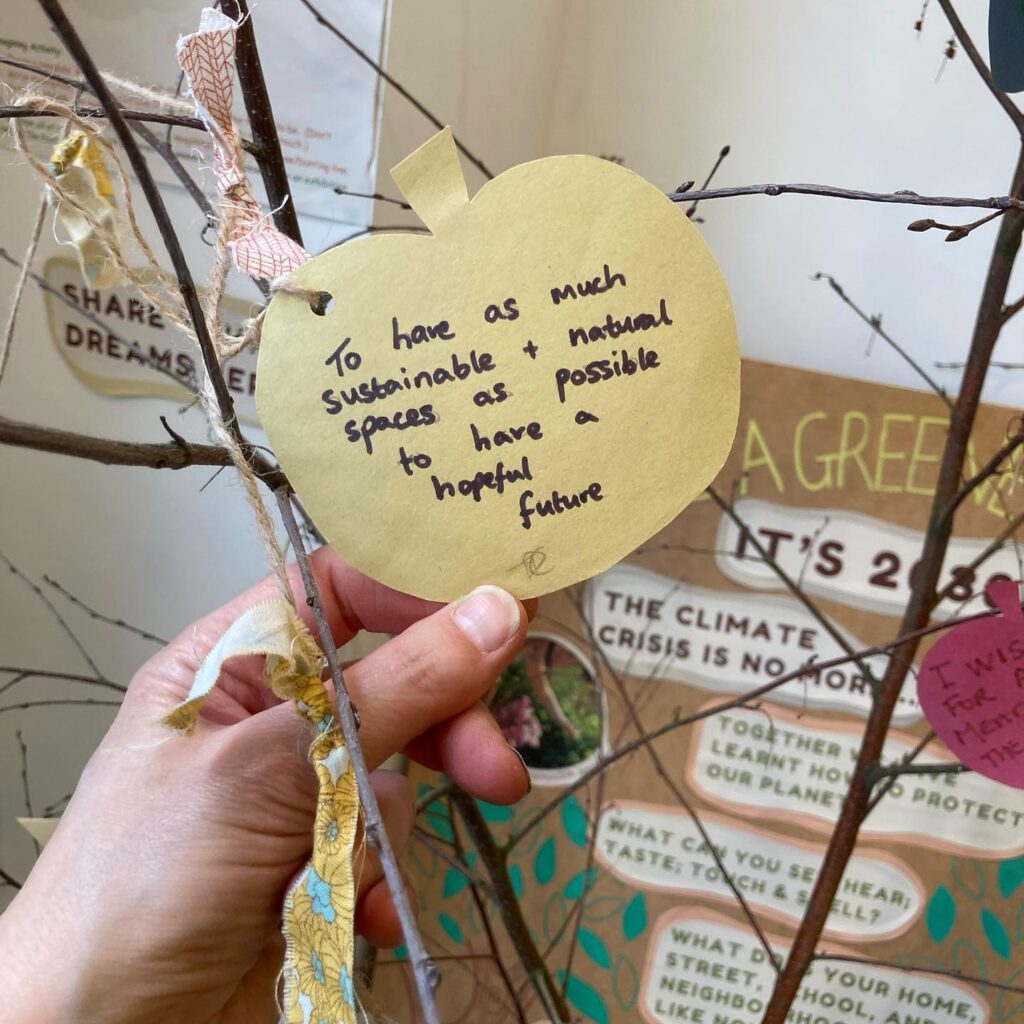
Our Creative Imaginings sessions are intended to invite creative responses, as we adopt new perspectives to explore nature in our urban areas, and discover ways to appreciate and revitalise our local ecosystem.
Photo: Jo Hutchison
Practical Permaculture Pathway for schools
This year, our focus for our ‘Growing to School project is on further developing a Practical Permaculture Pathway of transformative and curriculum linked sessions for children in schools.
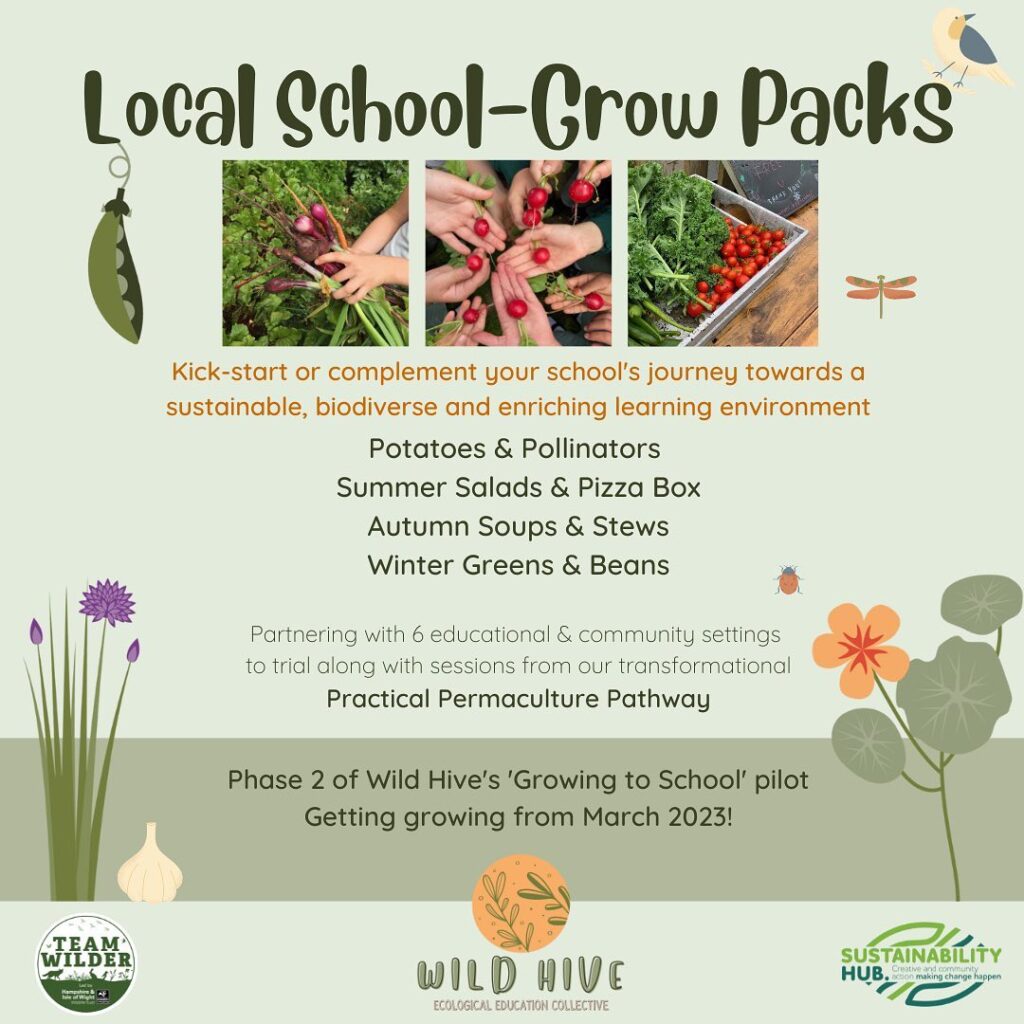
During phase 2 of our pilot project, we will be running a series of Children in Permaculture-informed sessions at Scantabout Primary School in Chandlers Ford – aligned with our seasonal Local (School) Grow Packs that the children will be growing.
We are on the steering group for Southampton University’s Growing Wild Citizens project and considering ways that offerings such as ours could support hyper-local ‘hives’ of schools and practitioners – for sustainable school-site based growing/nature-led sessions. Also, as Community Representatives for HIWWT’s Team Wilder, we are looking into ways to develop our Practical Permaculture Pathway as a route that schools could follow to naturally be recognised as an HIWWT Wilder School: https://www.hiwwt.org.uk/Schools-groups.
Local (School) Grow Packs & Local (Home) Grow Kits
Developing and fully testing our Organic Local (School) Grow Packs is our other area of focus for 2023-24, and we are fortunate to have some excellent Seed Team advisors. Paul Dibden and Sarah Flynn are both HCF stakeholders, and Debra Cave is a Permaculture practitioner with a passion for perennials. We are also having help and advise from our friends at Aldermoor Community Farm.
Our four seasonal Local Grow Packs have been designed to grow meals that can be harvested within the school terms, but not necessarily needing to be grown in school settings. We are very grateful to the following test bed sites for allowing us to trial our Local Grow Packs with their user-groups – to see how much more ecological growing engagement, enthusiasm and enabling results from direct involvement and linked learning:
Toynbee Secondary School
Youth Options’ Outdoor Learning Centre
Aldermoor Community Farm
The Point
Highbridge Community Farm
Photo: Jo Hutchison
Growing beyond the plot
Alongside these longer term projects and activities, we’re using our Local Grow Packs and Kits for small group and one-off growing sessions, and are going to be championing the plotting of more accessible community growing spaces within our local “Good to Grow Network” – to enable more sharing of time, space, skills, resources and harvests.
From its inception in the dark days of pandemic lockdown to its current set of thriving local initiatives, Wild Hive Ecological Educational Collectiveis going from strength to strength.In the first of this series,Founder Jo Hutchison describes how she envisioned and developed Wild Hive.
Find out about the Wild Hive outreach projects here. Discover here how Wild Hive is helping to grow a new HCF team: GreenTeam@HCF.
Cast your minds back to the darker days of lockdown, and you’ll remember how fortunate many of us felt to have the sanctuary of Highbridge Community Farm; the space to draw breath while the children roamed freely; and the reassurance of knowing that we could access the food we were still growing together (albeit, at a social distance). At a time when we were learning new ways to connect with each other, many people were also finding comfort in a renewed connectedness with nature. As the pace of life slowed, and the man-made noise quietened, nature found its voice. And we started to listen.
Inspiration for a local future
Like many others, I sought to counter the troubling daily news briefings with podcasts that offered hope and inspiration. It was during one of my ‘hour-a-day’ walks around our local neighbourhood, that I heard Helena Norberg-Hodge, founder of Local Futures, sharing her thoughts about a localised future – where most of our food comes from nearby farmers to ensure food security year round; and money circulates in the local economy to grow prosperity. A localised future where, essentially, we take stock of the wealth of skills and assets we have, and connect them together to re-discover ways to live more lightly and in harmony with nature and each other.
If this interview and the Local Futures film, ‘The Economics of Happiness’ sowed the seed for a grass-roots initiative in my mind, it was the energy from Pam Warhurst (founder of Incredible Edible), the pragmatism of Transition Network (remembering how Eastleigh Transition Network had conceived Highbridge Community Farm), and ultimately, the lockdown TED talk from Transition founder, Rob Hopkins, that gave me the fresh perspectives I needed for my wilder ideas to germinate.
Time to outreach community farming?
With the clarity that came from those solitary walks, I thought hard about what it was that had enabled Highbridge Community Farm to thrive for over a decade. Struck by the abandoned school fields and empty growing beds, I contemplated how school grounds could become the sustainable and bio-diverse National Education Nature Park that the Department for Education was calling for, whilst serving the immediate needs of the children – many of whom were struggling with their mental health due to the disruption to their education. I started dreaming up various ways we could potentially take community farming to the community.
There and then.
Here and now.
Could a combination of stakeholdership rather than voluntary helpers, and time-slotted year-round access to shared ‘Education/Community Farms’ on the edge of school grounds or educational sites, enable many more members of our local community to enjoy the same benefits as our Highbridge Community Farm stakeholders do?
Why, I wondered, when so many were having to stay home to school, and too many didn’t have gardens of their own, weren’t the turfed (or plastic-grassed) school fields being transformed into educational food forests, or flourishing outdoor nature-classrooms? Surely, it was more critical then than ever to be passing on the practical growing skills our young people would need for such an uncertain future?
As pressures continued to mount to agree, let alone reach, essential Net Zero targets, wasn’t it imperative that we proactively encouraged the next generation to take one of the most positive environmental actions of all – to grow the means to capture carbon, whilst growing healthy food; increasing biodiversity; protecting nature; and helping to reduce the carbon emissions that are ‘wrapped into’ the food that is transported from further afield?
From “What if?” to “What next?”
In the spirit of Transition founder, Rob Hopkins’, profound question “From What If To What Next?”, I asked myself:
What positive social and environmental impacts would be felt if we created the conditions for climate literacy to be deeply understood through its practice, and the savouring of resulting ‘riches’; as opposed to majoring on the theory, with the risk of focussing on what we as humans might be denied if we are to live more sustainably?
What if we turned the fear and uncertainty on its head, and instead took the nourishing aspects of community farming into our schools and neighbourhood growing spaces, and encouraged more ecological and regenerative growing practices?
What if we harvested the wealth of skills and expertise accumulated in our community farm, and shared it with larger cohorts and diverse groups of people ‘on their doorsteps’?
Could we help create a cultural shift towards ‘active hope’ and optimism if we listened to, learned from and involved young people in the creation of more shared and “wildly abundant” local landscapes (“wildly abundant” being my, then 7-year old, son’s words)?
What if we simply taught more children how to grow and make a bowl of nourishing soup? What ripple effects might be felt throughout our local community?
Extending the Community Farm objectives
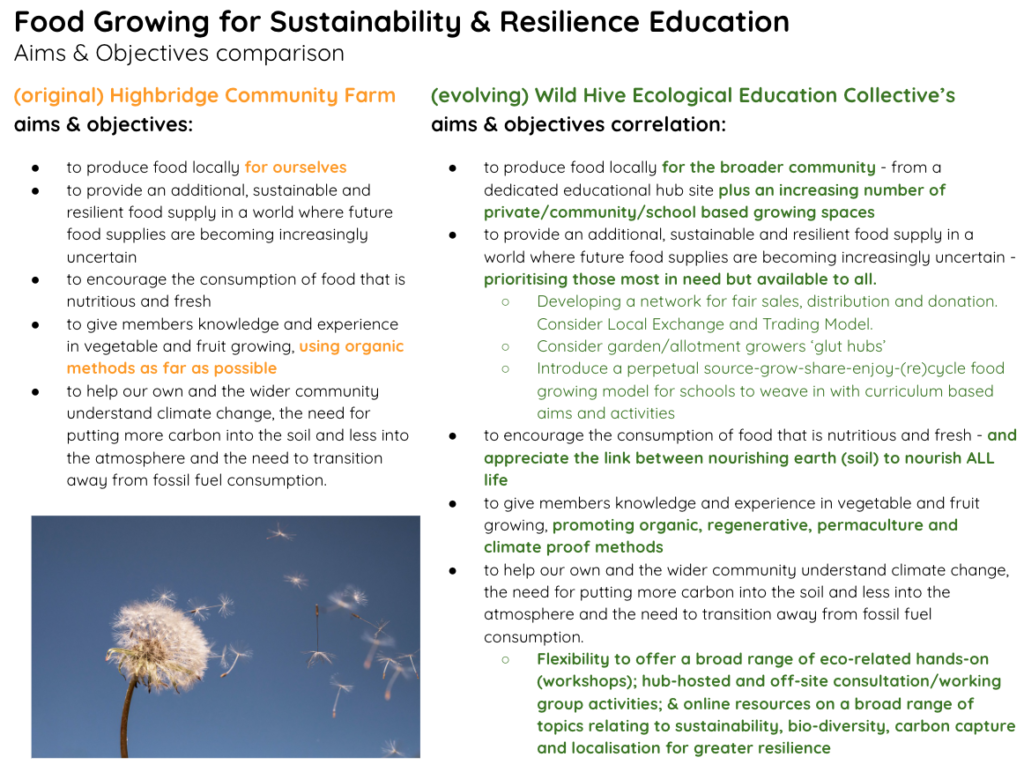
As the lockdowns of 2020 continued into 2021, and life became more precious and precarious than ever, it felt imperative that we reconsider ways to approach educational and community growing projects and efforts. With the help of HCF’s Steve Grundy, we put out a survey to all the Farm stakeholders to gauge whether they felt the Farm was still meeting its original objectives and to see what appetite there was for more educational outreach. (You can see the results of the survey here.)
Informed by some of these responses, gradually the aims of our Wild Hive Ecological Education Collective took root in my mind – to do whatever we could to engage, enthuse and enable even more local growing and/or access to locally grown food (on whatever scale) – to improve health and wellbeing; to support nature (including ourselves) and ultimately, to protect our planet. Correlating our aims and the objectives of Highbridge Community Farm led us to being an offshoot initiative rather than simply part of the farm.
Photo: Jo Hutchison
Fortunately, some other farm stakeholders shared my view and helped to get Wild Hive off the ground.
So, that was then, and this is now!
Becoming Wild Hive
Since Autumn 2021, we have grown from a handful of pioneering ‘farm-hands’ and educators, keen to develop the idea of educational outreach from Highbridge Community Farm, into a growing collective of passionate people, committed to turning our numerous ideas for a ‘greener, brighter future for all’ into reality.
Using Looby Macnamara’s ‘People in Permaculture’ design web, I started to design the Wild Hive Collective that was gradually taking shape. Here you can see the summary that I presented for my Children in Permaculture Design Certificate:
Photo: Jo Hutchison
Within our core team, we now have myself, the original Courgette Team Leader at HCF, with a background in Communications & Community Engagement; Lizzie Dunn, an RHS trained Horticulturist, Landscape Manager and School Grounds Guru; Claire Clarke, an Ecologist and fellow HCF ‘old-timer’; Dedj Liebrandt, a Medical Herbalist with a desire to educate others; and Rachel Carey, an Education Consultant and School Green Team Champion.
In Autumn 2022, we registered as a Community Interest Company in order for our enterprise itself to become sustainable.
Since then, we’ve been working hard to build a network of collaborators, supporters, and local educational and community garden sites and to develop our educational outreach initiative.
Discover our projects
Find out more about our Wild Hive projects in the next blog in this series. Discover here how Wild Hive is going back where it all started to grow a new team at Highbridge Community Farm – the Green Team@HCF.
The fields that we use for Highbridge Community Farm are next to some historic water meadows and a Site of Special Scientific Interest, also owned by our landlord, Mr Henry Russell. Lyndsey runs Highbridge Conservation Group. Here, she explains how it came about and how you can find out more.
By Lyndsey Rowe
I run Highbridge Conservation Group. I ran the Legacy Festival at the farm from 2016 to 2021. (Sorry for all the noise and disruption but we raised 40 thousand pounds to support people with brain cancer!) Henry was so kind and helpful and over that time and I saw how much he does for so many people as well as running the farm.
Late in 2021, we were chatting and he told me about the meadows and the SSSI and that he didn’t have the time to maintain it as he would like and that other similar sites have groups of volunteers to help. He had been so kind helping me raise funds for my late son’s charity that I thought I would do something to help and say thank you and Highbridge Conservation Group was started in January 2022.
We started by clearing the banks of the stream to provide better habitat for the endangered Southern Damsel Fly, the reason that the meadows are designated as a Site of Special Scientific Interest (SSSI), and began work on the 17th century water meadows clearing channels and flooding them to provide early grass for the cattle and a better habitat for wetland birds. You may have also seen us conducting surveys of the flora and fauna, working in the woodland and in January 2023 we planted a British native hedgerow of one thousand trees across the river.
We have some great plans for the future including a visitor centre, facilities for local school groups, bird watching and day workshops. I hope you can join us.
This article is from information by Penny Velander, one of the Expert Growers at HCF.
Squashes are popular, versatile crops at Highbridge Community Farm and usually perform well for us. Let’s take a closer look at the four varieties that we grew this year and share some tips on making them last after they’ve been picked.
Crown Prince
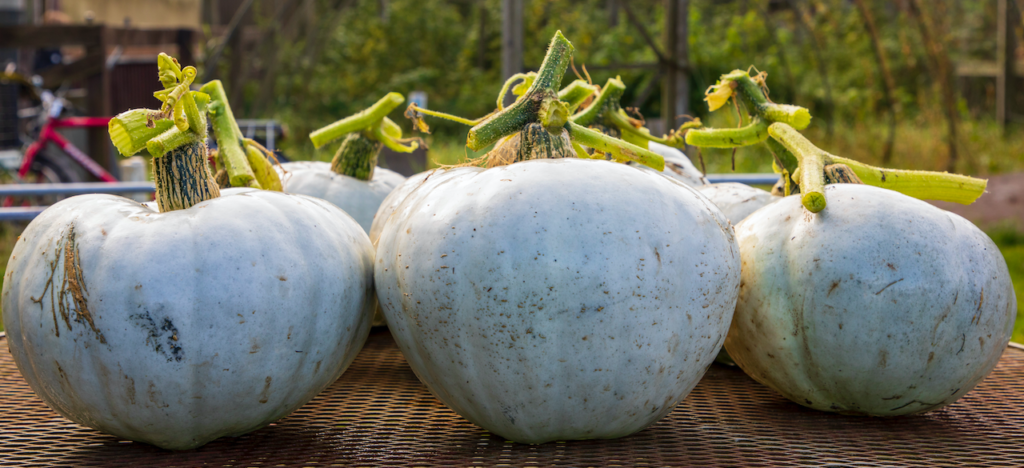
This a wonderful Antipodean squash with tasty, thick, firm orange flesh, distinctive grey-blue skin, and a savoury depth that is lacking in a butternut. The Crown Price Squash is particularly good for soups, risottos and roasts well. It has hard skin and stores well.
Photo: Penny Velander
Butternut
The Butternut Squash has become a firm favourite in the kitchen. The orange flesh stays firm when cooked and the skin is also edible and softens when roasted. It’s a very versatile squash that is good in soups or simply roasted and mashed with a dollop of butter, cream and cinnamon It has softer skin than the tough Crown Prince, but still stores well.
Photo: Highbridge Community Farm (Steve Grundy)
UCHIKI KURI
This Japanese Squash – also known as “Red Onion Squash” – has red/orange pear-shaped fruit with thin but firm flesh that provides a very delicate and mellow flavour similar to the taste of chestnuts. Uchiki kuri squash has deep-orange flesh that passes a rich gold colour to any dish it is added too – especially lovely in risotto. Like butternut, it has softer skin but it does not store as long as the other varieties.
Photo: Highbridge Community Farm (Steve Grundy)
Kabocha
This is another Japanese squash and a first time crop for us this year. It has thick firm flesh, good colour, excellent flavour and, with its dark green hard skin, it stores well. A good all-rounder!
Photo: Highbridge Community Farm (Steve Grundy)
Getting the best from your squash
Grown squash don’t do well sitting around in the cold or damp so, as soon as ours are ready, we harvest the lot at once. Then, we need to keep them carefully to get the most out of them over the coming weeks. Here’s what we advise:
Do not carry your squash by the stem. If the stem breaks off, the squash will not store for as long.
Place the squash on a sunny window ledge for approximately two weeks to cure it. This hardens the skin and dries out the stem to extend storage time and mellows the flavour by turning the starch to sugar.
After you’ve cured it, place the squash in a cool, frost free environment until needed – I put them in a box under the bed in the spare room.
Leave for at least a month for the flavour to mature. The longer it is stored, the better the flavour becomes.
Check regularly as not all squash will store for a long time. At any sign of rot, use immediately.
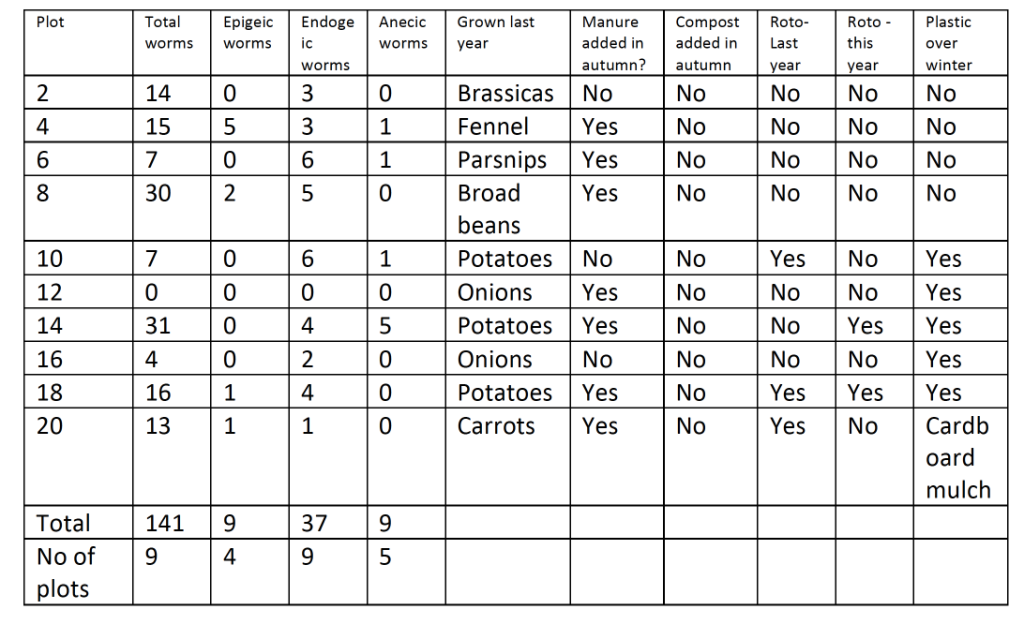
In early February and March 2018, Dr Jackie Stroud, a Natural Environment Research Council Soil Security Fellow at Rothamsted Research, led a project to study the worms in farm soils. 126 farmers took part. They dug 10 pits in one field, each 20 cm x 20 cm x 20 cm, in one field. They counted the number of adult worms in the sample (adults are identified as those having a saddle on their bodies) and allocated them to one of three main types of earthworm. Each of these worm groups has a different function.
Epigeic surface worms (the small, surface, red ones) break down surface litter and are a good source of food for native birds, such as thrushes and blackbirds.
Endogeic topsoil worms (the medium, pale ones which are grey, pink or a darker green) mix soil and mobilise nutrients for plant uptake and so support crop productivity.
Anecic, deep-burrowing large worms (larger pencil-sized ones which are heavily pigmented red or black) are the drainage worms which can form vertical burrows of up to 2m deep. These help with water infiltration and deep plant burrowing.
In April 2019, we conducted the same experiment over our ten plots, with a few teams adding a second count. Our results are below and make interesting reading. They are just a snapshot but they give us a baseline for further monitoring and discussion.