There’s more than you think to getting strong edges around each plot. Alister ran some workshops to show how it’s done.
This time of year is perfect for housekeeping jobs, such as tidying up the edges of the plots. Tidy edges help to demarcate the plots and the paths, to reduce the spread of weeds at the edges and, importantly, to avoid accidents when long edge grass hides a dip between the soil and the path.
Thanks to Alister for his expert advice. Talk to your TL if you’re interested in learning more.
You’ll need:
Edging iron
Sharp pair of edging shears
Decking board
String line – long enough to run the full length of the plot
2 bricks
A small-ish fork – not a large digging fork but not a handheld one either
Small soil rake
Wheelbarrow
Bucket
All of these are available at the Farm.
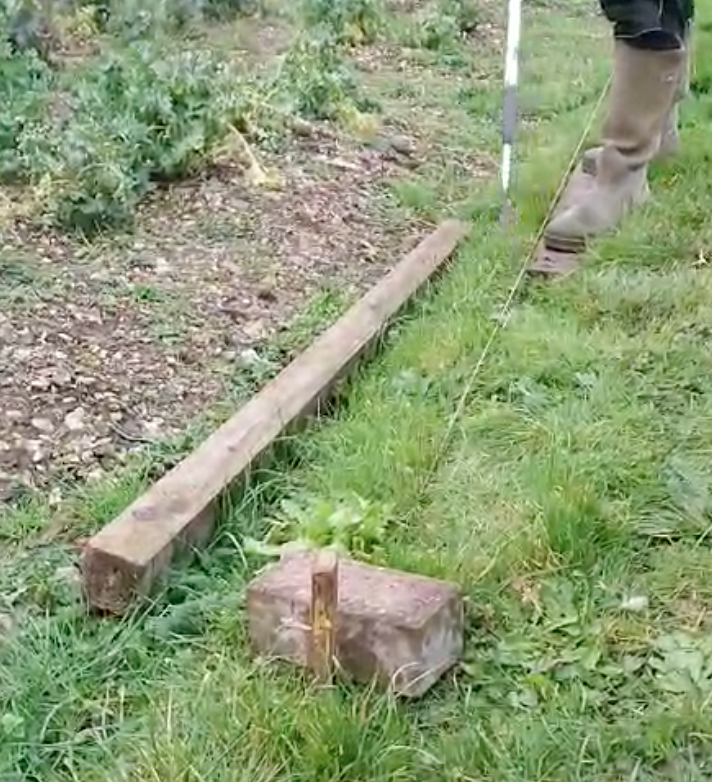
Start by laying the guide line straight and tight. Anchor it with the bricks and lay the decking board against it. The bricks help to weigh down the line; for example, to get it to ground level when you’re aligning with an existing edge.
Use a shortish board that you can spread your feet across it. Too long and it can move on our uneven ground. It can also move if your feet aren’t anchoring it.
Photo: Highbridge Community Farm (Alister)
Cut against the line with your edging iron. Make sure your edging iron is the correct way round (some have a bulge on one side).
When you continue the edge, such as after you have to move the line because it wasn’t long enough, start cutting from where you left off rather than starting from the far end and meeting in the middle. This helps to avoid a dog-leg.
Getting started
Dig out the weeds and grass up to your line. Shake off surplus soil so that we keep that on the plots. Cut some depth into the edge with your edging iron (don’t stand on your cut line!). Try to keep the edging iron vertical as you cut some depth into the edge and don’t use your feet to push it into the soil because you’ll start to become inaccurate. Flick surplus soil away from your cut edge onto the plot. You’re looking for a nice clean slope away from your line.
Digging out the edge
Clip the grass edges . Be careful to use the edging shears vertically (it can be easy to start cutting at an angle) and let one arm do the work while the other stays steady.
Keep your edges in good shape with a trim every other week. When the edges are tidy, people don’t tread on them which, in turn, helps to keep them in good shape.
Clipping the edges
Any more tips for strong edges? Let us know in a comment.
For all the backyard growers who have a fruit tree in a pot or a border, with the autumn solstice a few days away and frosts on the horizon, these are the last weeks to complete your summer pruning. Alex, HCF Orchard Team Leader, shares his tips.
Why now?
Summer pruning is best done after Summer has peaked in late July and dormancy starts to kick in. Once the tree has detected that the days are getting shorter and it gets an ever-smaller return investing in new leaves, it will switch from producing green to enlarging its fruit. It’s at this moment that, if you prune back any branch, there will be little attempt to regrow. If you want to check the size of the tree, you have to prune it in summer, never at winter.
Other side effects of pruning at summer is letting the sun in, ripening the fruit. The sun, coupled with the hormone change in the branches, will also accelerate the formation of fruit buds for the next season, and mature and thicken the remaining branch.
Use sharp, clean tools
When pruning, always use a sharp pair of secateurs that won’t tear or crush the wood but will make neat cuts. If the wood is too thick for secateurs, use a different tool like a saw. Make sure that you clean them well to avoid diseases entering the trees core: a domestic tabletop disinfectant spray will work to wipe down the blades. If your tree has grown tall, or has some areas difficult to reach, consider buying yourself some pole pruners. They do a quick and efficient job.
Work in stages
First, check the tree for any broken, damaged, dead, or diseased branches and thin them out or cut them back first. Then thin out any branches that are growing inwards to the tree, or simply look out of place, sagging badly or crossing any other main branch. You can thin them down to one or two leaves.
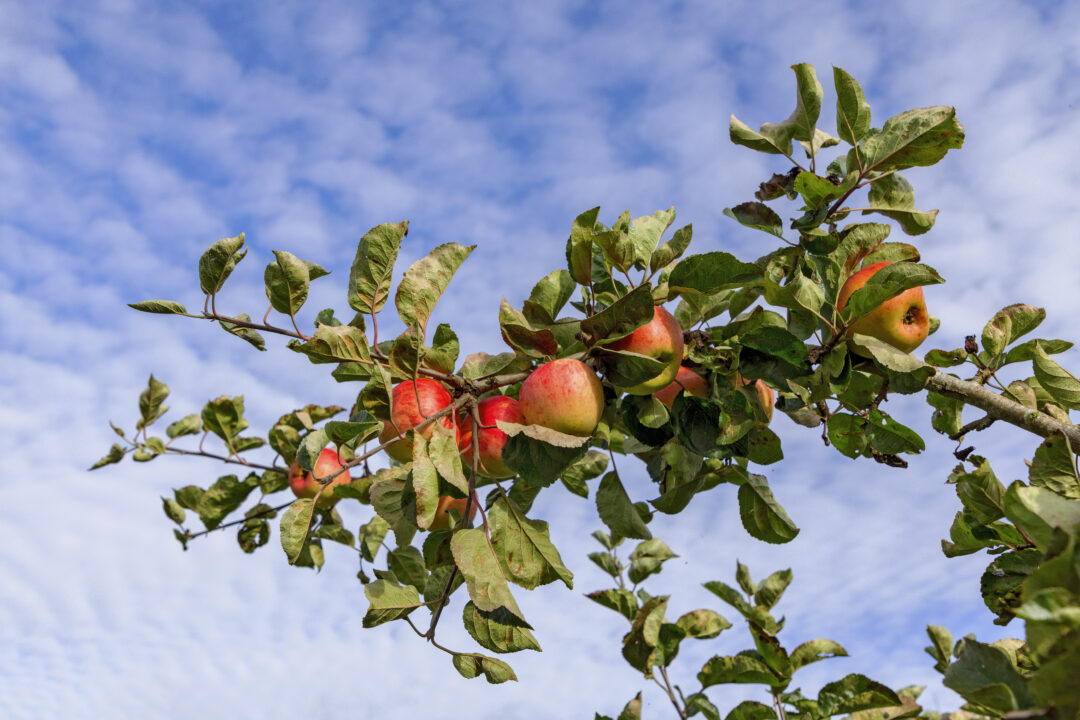
On the remaining branches, look for this year’s growth: it will look distinctively shinier, with a glossier finish on the wood and more flexible than last year’s growth, which will look darker and feel stiff. Find the node where the new growth has started from. If the new growth is longer than a palm’s length (20cm+), then count three leaves up from the base of the growth. Cut the branch here or in the closest leaf that points outwards of the tree, be it the second or the fourth leaf. This is called the “Lorette method”.
Think in terms of negative space too, considering the void that you want to leave in the centre of the tree and between main branches.
If there is a branch loaded with fruit that is not quite ripe yet to harvest, you can prune the tree in two goes. Do some now and another go after you’ve taken that fruit off the tree.
Summer pruning is more dramatic than winter pruning because of all the canopy you drop but try not to shave off more than 25% of a tree in one go. Don’t cover the wounds from your cuts because they will heal worse and risk trapping any disease inside.
Don’t hesitate now
Whichever type of apple tree you grow, regular pruning is important if you want it to stay healthy and produce lots of fruit. Your last date for summer pruning is at least two weeks before the first winter frost to allow the tree to heal itself. Sharp weather will soon be upon us so, if you have fruit trees, don’t wait to get that summer pruning done.
Let us know if you have any questions about summer pruning.
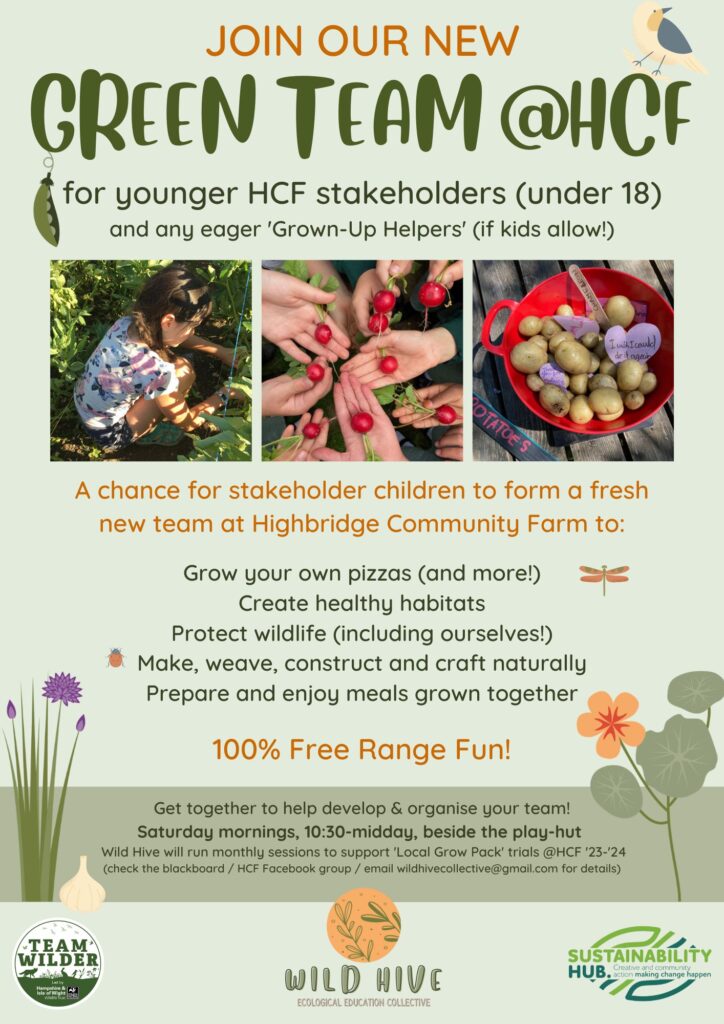
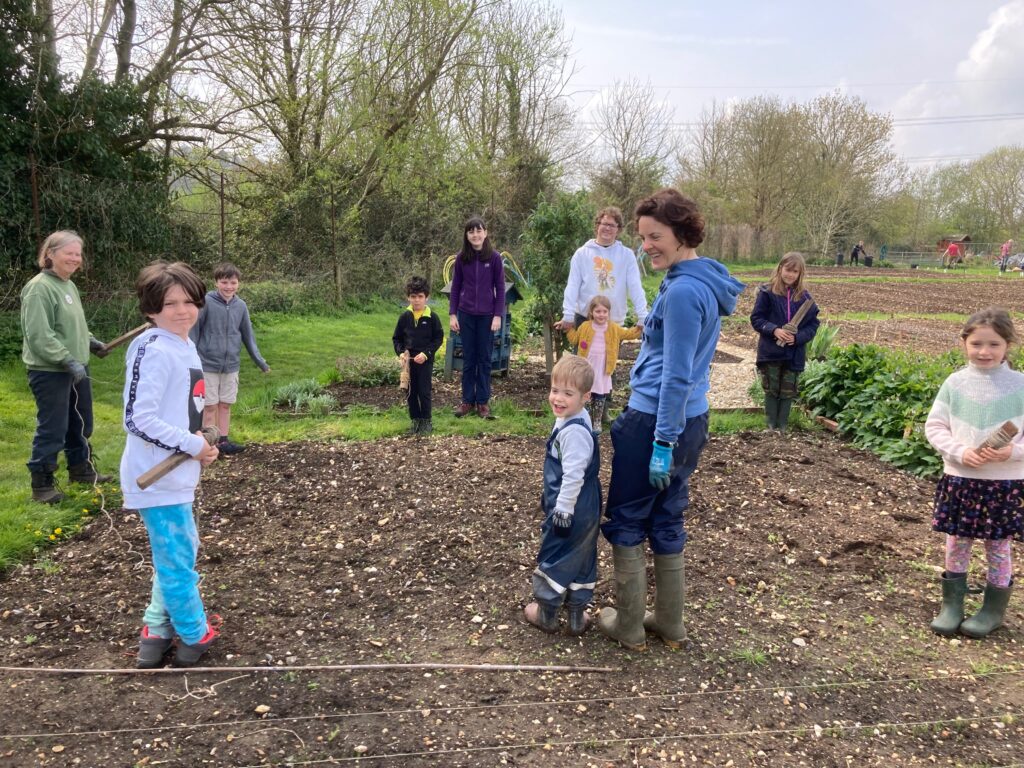
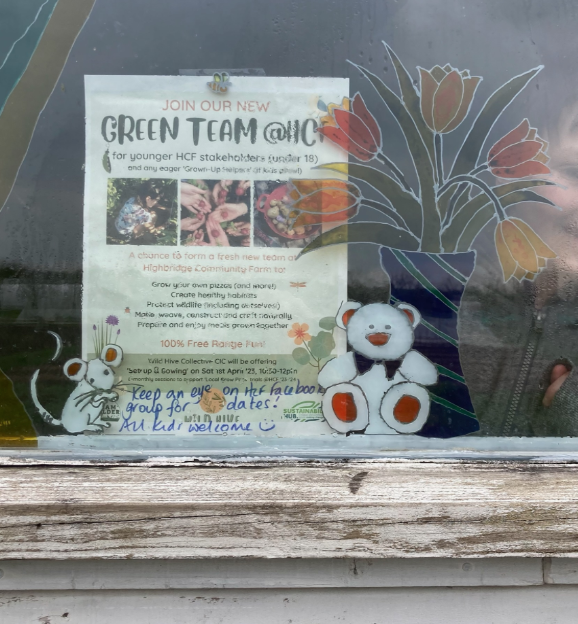
Wild Hive Ecological Educational Collective is helping us to grow a new HCF team. Welcome to Green Team@HCF! Wild Hive founder, Jo Hutchison, explains how it works.
Find the story of Wild Hive here and about the Wild Hive outreach projects here.
Photo: Jo Hutchison
After quite a journey to date, Wild Hive is delighted to have come full circle back to Highbridge Community Farm from which our educational outreach initiative originally stemmed.
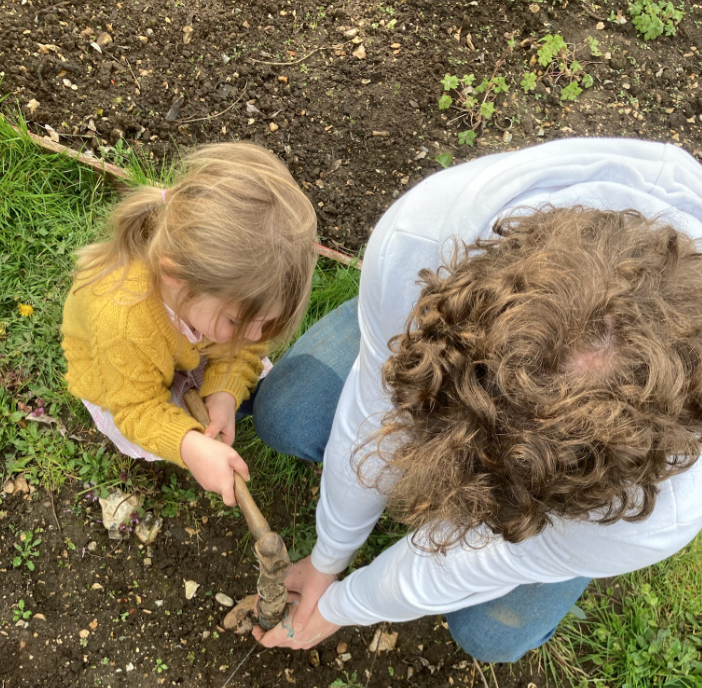
We’re very excited to have been offered a couple of good sized patches on Jim’s team’s plots – particularly because the children now have their own area right beside their play-hut and pollinator garden – in which to grow their own! These areas will amply fit all four of our Local Grow Packs, and hopefully leave a little space for other things the children might wish to try.
Photo: Jo Hutchison
Wild Hive Collective CIC is helping the Green Team @HCF to form, and, whilst trialling the Local Grow Packs, will offer sessions to support and monitor the growing. The idea is that with a little guidance and initial steer, the children will gradually organise themselves, manage their activities, and develop a sense of agency with space of their own in the heart of Highbridge Community Farm.
Certainly in the initial stages, it will be helpful to have some adult helpers for input and guidance (when wanted!). If you are a stakeholder and either you or you child(ren) are in joining the Green Team @HCF and/or supporting Wild Hive in any way, please complete this form.
The intention is that Wild Hive Collective CIC will use the sowing, growing & harvesting of the Local Grow Packs as an opportunity to help this team of younger ‘farm-hands’ (currently HCF stakeholder children only) to gather together and to sow, harvest and enjoy meals that they have grown, whilst they naturally become the ecological growers and nature custodians of the future.
Photo: Jo HutchisonPhoto: Jo HutchisonPhoto: Jo Hutchison
Find out more
Find Wild Hive on Facebook and Instagram. If you’re an HCF stakeholder and you’d like to know more about Green Team@HCF or to get involved, find Jo at the farm or fill in this form.
Wild Hive Ecological Educational Collectivegets our local schools and neighbourhoods growing. Founder Jo Hutchison shares how they’re doing this.
Find the story of Wild Hive here. Discover here how Wild Hive is helping to grow a new HCF team: GreenTeam@HCF.
Permaculture design for people & place
We were very lucky to have been joined at the start of our journey by Liz Darley (Grow South Permaculture), who brought Permaculture principles to life for our expanding network at various local educational and community garden sites, including The Outdoor Wildlife Lodge at Otterbourne School, ‘The Hive’ (College House) in Compton (then Eastleigh College’s site), and Youth Options’ Outdoor Learning Centre in Bishopstoke.
Our projects and approach have been greatly informed by Children in Permaculture, and we continue to be helped and encouraged by that team and the network of practitioners and educators from The Permaculture Association.
Last year, we trialled a bespoke, condensed Practical Permaculture Intro mini-course with Eastleigh College’s Functional Skills/Enterprise students. We also realised the benefits of offering one-off Practical Permaculture Design Tasters, helping to draw active participants together at sites that are ripe for renovation.
‘Growing to School’ pilot
With the support from four local Primary Schools, in Spring 2022 we launched our ‘Growing to School’ pilot project, which involved:
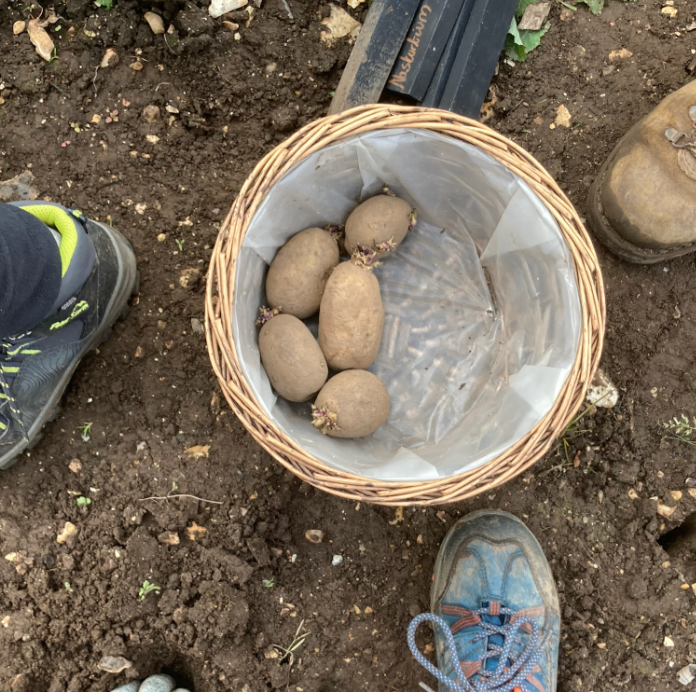
Creating 250 Little Local Grow Kits (Spring: Potatoes & Pollinators) for children to grow at home with the support of our online community (raising £550 for Save the Children’s Ukraine fund);
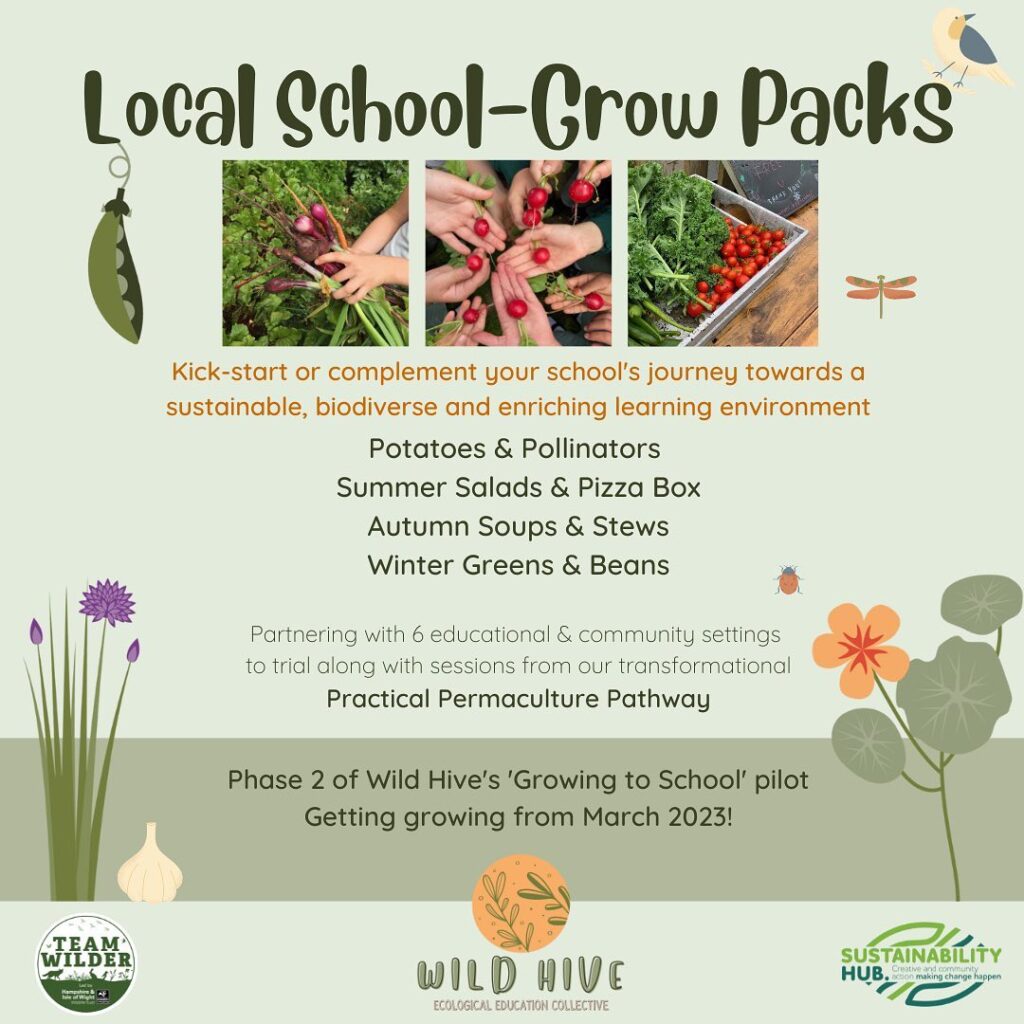
Developing Local Grow Packs to make immediate use of the existing beds and growing spaces in schools;
Trialling the formation of Green Teams of children and parents/carers to support growing activities; and,
Running some in-class Children in Permaculture-style growing sessions to enable more children to have the opportunity to ‘grow a meal’ and be part of the perpetual growing cycle.
Changemakers at The Point (Eastleigh’s new Sustainability Hub)
Autumn 2022 marked the start of our Changemaker residency at The Point – as part of Eastleigh’s new Sustainability Hub. This was the prompt we needed to register as a Community Interest Company in order for our enterprise to become sustainable itself.
With a little seed funding from The National Lottery’s Community Fund (via The Point), we were able to develop and run a series of nature-led “Small but Mighty” Creative Imagining sessions for families and adults in Spring ‘23, and will continue to support The Point’s Big Ideas’ events and offer more seasonal sessions throughout the year.
Our Creative Imaginings sessions are intended to invite creative responses, as we adopt new perspectives to explore nature in our urban areas, and discover ways to appreciate and revitalise our local ecosystem.
Photo: Jo Hutchison
Practical Permaculture Pathway for schools
This year, our focus for our ‘Growing to School project is on further developing a Practical Permaculture Pathway of transformative and curriculum linked sessions for children in schools.
During phase 2 of our pilot project, we will be running a series of Children in Permaculture-informed sessions at Scantabout Primary School in Chandlers Ford – aligned with our seasonal Local (School) Grow Packs that the children will be growing.
We are on the steering group for Southampton University’s Growing Wild Citizens project and considering ways that offerings such as ours could support hyper-local ‘hives’ of schools and practitioners – for sustainable school-site based growing/nature-led sessions. Also, as Community Representatives for HIWWT’s Team Wilder, we are looking into ways to develop our Practical Permaculture Pathway as a route that schools could follow to naturally be recognised as an HIWWT Wilder School: https://www.hiwwt.org.uk/Schools-groups.
Local (School) Grow Packs & Local (Home) Grow Kits
Developing and fully testing our Organic Local (School) Grow Packs is our other area of focus for 2023-24, and we are fortunate to have some excellent Seed Team advisors. Paul Dibden and Sarah Flynn are both HCF stakeholders, and Debra Cave is a Permaculture practitioner with a passion for perennials. We are also having help and advise from our friends at Aldermoor Community Farm.
Our four seasonal Local Grow Packs have been designed to grow meals that can be harvested within the school terms, but not necessarily needing to be grown in school settings. We are very grateful to the following test bed sites for allowing us to trial our Local Grow Packs with their user-groups – to see how much more ecological growing engagement, enthusiasm and enabling results from direct involvement and linked learning:
Toynbee Secondary School
Youth Options’ Outdoor Learning Centre
Aldermoor Community Farm
The Point
Highbridge Community Farm
Photo: Jo Hutchison
Growing beyond the plot
Alongside these longer term projects and activities, we’re using our Local Grow Packs and Kits for small group and one-off growing sessions, and are going to be championing the plotting of more accessible community growing spaces within our local “Good to Grow Network” – to enable more sharing of time, space, skills, resources and harvests.
From its inception in the dark days of pandemic lockdown to its current set of thriving local initiatives, Wild Hive Ecological Educational Collectiveis going from strength to strength.In the first of this series,Founder Jo Hutchison describes how she envisioned and developed Wild Hive.
Find out about the Wild Hive outreach projects here. Discover here how Wild Hive is helping to grow a new HCF team: GreenTeam@HCF.
Cast your minds back to the darker days of lockdown, and you’ll remember how fortunate many of us felt to have the sanctuary of Highbridge Community Farm; the space to draw breath while the children roamed freely; and the reassurance of knowing that we could access the food we were still growing together (albeit, at a social distance). At a time when we were learning new ways to connect with each other, many people were also finding comfort in a renewed connectedness with nature. As the pace of life slowed, and the man-made noise quietened, nature found its voice. And we started to listen.
Inspiration for a local future
Like many others, I sought to counter the troubling daily news briefings with podcasts that offered hope and inspiration. It was during one of my ‘hour-a-day’ walks around our local neighbourhood, that I heard Helena Norberg-Hodge, founder of Local Futures, sharing her thoughts about a localised future – where most of our food comes from nearby farmers to ensure food security year round; and money circulates in the local economy to grow prosperity. A localised future where, essentially, we take stock of the wealth of skills and assets we have, and connect them together to re-discover ways to live more lightly and in harmony with nature and each other.
If this interview and the Local Futures film, ‘The Economics of Happiness’ sowed the seed for a grass-roots initiative in my mind, it was the energy from Pam Warhurst (founder of Incredible Edible), the pragmatism of Transition Network (remembering how Eastleigh Transition Network had conceived Highbridge Community Farm), and ultimately, the lockdown TED talk from Transition founder, Rob Hopkins, that gave me the fresh perspectives I needed for my wilder ideas to germinate.
Time to outreach community farming?
With the clarity that came from those solitary walks, I thought hard about what it was that had enabled Highbridge Community Farm to thrive for over a decade. Struck by the abandoned school fields and empty growing beds, I contemplated how school grounds could become the sustainable and bio-diverse National Education Nature Park that the Department for Education was calling for, whilst serving the immediate needs of the children – many of whom were struggling with their mental health due to the disruption to their education. I started dreaming up various ways we could potentially take community farming to the community.
There and then.
Here and now.
Could a combination of stakeholdership rather than voluntary helpers, and time-slotted year-round access to shared ‘Education/Community Farms’ on the edge of school grounds or educational sites, enable many more members of our local community to enjoy the same benefits as our Highbridge Community Farm stakeholders do?
Why, I wondered, when so many were having to stay home to school, and too many didn’t have gardens of their own, weren’t the turfed (or plastic-grassed) school fields being transformed into educational food forests, or flourishing outdoor nature-classrooms? Surely, it was more critical then than ever to be passing on the practical growing skills our young people would need for such an uncertain future?
As pressures continued to mount to agree, let alone reach, essential Net Zero targets, wasn’t it imperative that we proactively encouraged the next generation to take one of the most positive environmental actions of all – to grow the means to capture carbon, whilst growing healthy food; increasing biodiversity; protecting nature; and helping to reduce the carbon emissions that are ‘wrapped into’ the food that is transported from further afield?
From “What if?” to “What next?”
In the spirit of Transition founder, Rob Hopkins’, profound question “From What If To What Next?”, I asked myself:
What positive social and environmental impacts would be felt if we created the conditions for climate literacy to be deeply understood through its practice, and the savouring of resulting ‘riches’; as opposed to majoring on the theory, with the risk of focussing on what we as humans might be denied if we are to live more sustainably?
What if we turned the fear and uncertainty on its head, and instead took the nourishing aspects of community farming into our schools and neighbourhood growing spaces, and encouraged more ecological and regenerative growing practices?
What if we harvested the wealth of skills and expertise accumulated in our community farm, and shared it with larger cohorts and diverse groups of people ‘on their doorsteps’?
Could we help create a cultural shift towards ‘active hope’ and optimism if we listened to, learned from and involved young people in the creation of more shared and “wildly abundant” local landscapes (“wildly abundant” being my, then 7-year old, son’s words)?
What if we simply taught more children how to grow and make a bowl of nourishing soup? What ripple effects might be felt throughout our local community?
Extending the Community Farm objectives
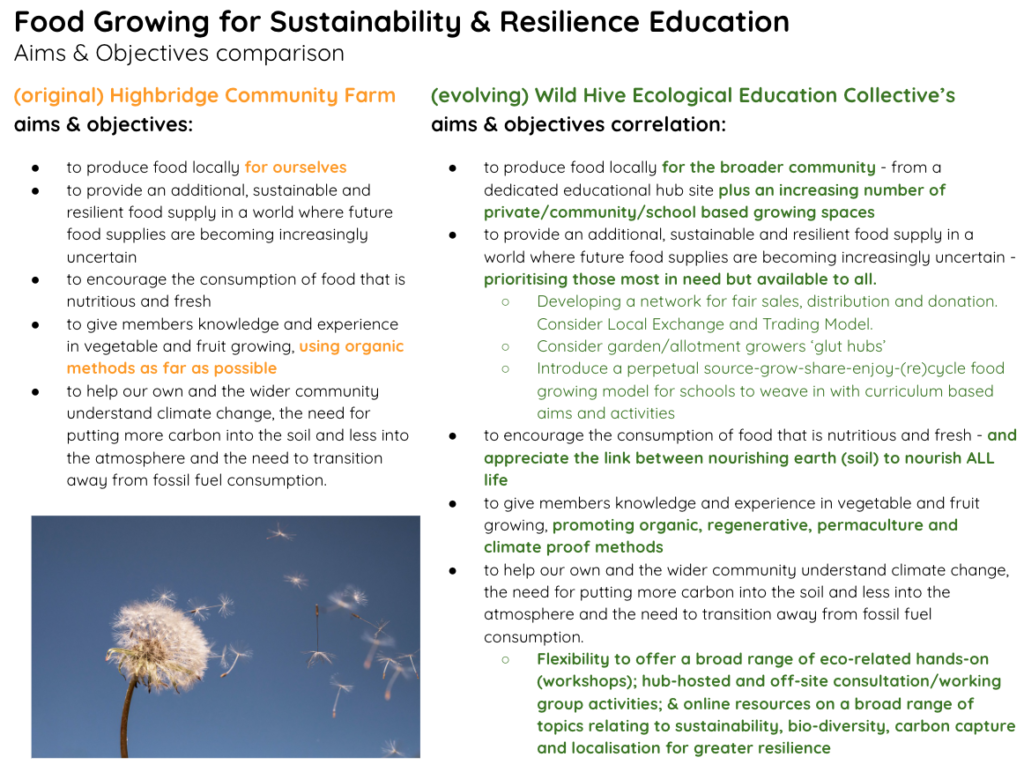
As the lockdowns of 2020 continued into 2021, and life became more precious and precarious than ever, it felt imperative that we reconsider ways to approach educational and community growing projects and efforts. With the help of HCF’s Steve Grundy, we put out a survey to all the Farm stakeholders to gauge whether they felt the Farm was still meeting its original objectives and to see what appetite there was for more educational outreach. (You can see the results of the survey here.)
Informed by some of these responses, gradually the aims of our Wild Hive Ecological Education Collective took root in my mind – to do whatever we could to engage, enthuse and enable even more local growing and/or access to locally grown food (on whatever scale) – to improve health and wellbeing; to support nature (including ourselves) and ultimately, to protect our planet. Correlating our aims and the objectives of Highbridge Community Farm led us to being an offshoot initiative rather than simply part of the farm.
Photo: Jo Hutchison
Fortunately, some other farm stakeholders shared my view and helped to get Wild Hive off the ground.
So, that was then, and this is now!
Becoming Wild Hive
Since Autumn 2021, we have grown from a handful of pioneering ‘farm-hands’ and educators, keen to develop the idea of educational outreach from Highbridge Community Farm, into a growing collective of passionate people, committed to turning our numerous ideas for a ‘greener, brighter future for all’ into reality.
Using Looby Macnamara’s ‘People in Permaculture’ design web, I started to design the Wild Hive Collective that was gradually taking shape. Here you can see the summary that I presented for my Children in Permaculture Design Certificate:
Photo: Jo Hutchison
Within our core team, we now have myself, the original Courgette Team Leader at HCF, with a background in Communications & Community Engagement; Lizzie Dunn, an RHS trained Horticulturist, Landscape Manager and School Grounds Guru; Claire Clarke, an Ecologist and fellow HCF ‘old-timer’; Dedj Liebrandt, a Medical Herbalist with a desire to educate others; and Rachel Carey, an Education Consultant and School Green Team Champion.
In Autumn 2022, we registered as a Community Interest Company in order for our enterprise itself to become sustainable.
Since then, we’ve been working hard to build a network of collaborators, supporters, and local educational and community garden sites and to develop our educational outreach initiative.
Discover our projects
Find out more about our Wild Hive projects in the next blog in this series. Discover here how Wild Hive is going back where it all started to grow a new team at Highbridge Community Farm – the Green Team@HCF.
HCF is pleased to say that few days ago we were visited by a couple of local scouts groups. Education activities are a core purpose of the farm and we were delighted in receiving and spending an afternoon with these young children introducing them to a range of farm based activities.
To accomplish this we raised a call for volunteers, who then gathered on Saturday to brainstorm four activities, each one of a duration of about 15/20’. We decided upon making the following four:
A seed sowing station where they could investigate what a big seed looks like, and then pot one themselves by preparing a pot (drainage holes), filling it with soil, sowing a seed and watering it. Accompanied by questions and answers regarding the seeds needs.
A compost activity, where they could add green and brown materials to the compost, plus a bit of manure, and help turn it over. All accompanied with explanations and questions about how it works and a visit to the final result, good black soil. (magic!)
A harvesting activity in the soft fruit cage, where they had a walk around ID and then got a punnet each and could harvest a selection of fruit for themselves
A vegetable hunt, where they were given a map of the farm and they had to find a total of 10 crops, two of them flowers, one herb and seven vegetables from the more usual ones to the more unusual
Last we gathered by the social area and had a round of questions and answers putting in common all that we had done during the afternoon, before breaking ranks and going home. As farm members leading the activity, we found that the duration 15-20 minutes per station worked really well, and that rotating them from one to another helped them stay focused and note get bored. We also found that groups of 6 were very manageable and we were very lucky with a sunny glorious afternoon weather after some very recent thunderstorms.
We also found that a crop treasure hunt was great fun and a much better way to help them zoom in and observe the crops, than pointing them out to them.
We encouraged everyone to bring their own trowel and gloves, and we kept common tools to a bare minimum while disinfecting the handles from one user to another.
The total cost of the activity was under 5GBP for 24 participants, namely some recyclable pots and a bag of seed soil. We also made an activity sheet for the scouts to print and bring for the afternoon, which many of them had.
Any new ideas and feedback for future visits is most welcome! You can also drop your name to volunteer leading any activity station in the future.