
Corvus corax makes a comeback

Dave Hubble looks at the raven.

Ravens were once widespread in Hampshire, especially in the New Forest, but by the mid 19th
century were almost extinct in the area, mainly due to persecution by gamekeepers and egg collecting. When gamekeeping activity dropped during the 20th century, ravens started to recolonise parts of the country, but a breeding pair wasn’t recorded in Hampshire until 2003. So, it was good to see, or more often hear, a pair in the riverside treeline by HCF during March and April, the middle of their breeding period. They are the largest of the crow family and can be identified by their shaggy throat-feathers, heavy beak and distinctive ‘kronking’ call. Their size isn’t always easy to gauge until they are seen next to other species such as carrion crows which often mob ravens.

They are opportunistic and omnivorous; they scavenge, hunt and forage – anything from grains and berries to invertebrates, larger prey and carrion. They are excellent problem-solvers and their seemingly high intelligence is an area of active research. In the US, they have even been recorded leading wolves and coyotes to large carcasses so they can be opened (ravens’ beaks aren’t strong enough to tear through large mammal hides); the ravens can then also feed on the remains. Their intelligence has been known, if not understood, for many centuries. In Norse mythology, Huginn (thought) and Muninn (memory or mind) are a pair of ravens that fly off to bring Odin information. In the Tlingit and Haida cultures of the Pacific Northwest, and on Kamchatka, ravens are both creator gods and tricksters. Closer to home, it is said that “if the Tower of London ravens are lost or fly away, the Crown will fall and Britain with it”. This is often thought to be an ancient superstition, but is likely to be a Victorian invention – even the current Ravenmaster thinks so (and yes, that’s a real job).

At HCF, we are lucky to host a raven territory, so they may have raised young – something to
celebrate. In any case, ravens are bright, playful, evocative… and back. The raven pictured is in flight at the farm.

If you enjoyed this, read more from Dave Hubble:
Wasps – what are they good for?

…rather a lot as it happens. Wasps get a bad press but are actually an interesting, beneficial and ecologically important group of insects.

This article from Dave Hubble is a great look at these unsung heroes and cultural references to them. You’ll never look at a wasp in the same way again!

Wasps get a bad press because they can sting, buzz around us when we have sugary food, and are poorly understood, but are actually an interesting, beneficial and ecologically important group of insects. There are about ten species of ‘typical’ wasps, including the hornet, in Britain, but depending on how ‘wasp’ is defined, there are something like 250 – 300 species, not including the 1,000-plus species of parasitic ichneumons which are related but aren’t really ‘wasps’. A few dozen of these are black-and-yellow to some extent, but most are not, and many are small. The more familiar species are social, much like honey bees, living in a nest with an egg-laying queen and sterile workers – sometimes you might see them scraping at wood to form pulp which they use to make the paper of their nest. Others are very different such as the bright metallic green, blue or red ‘jewel wasps’ which are tiny and beautiful – and may well be found in your garden. Others, like the potters and masons, make small mud turrets over the entrance to their burrows, or small mud ‘pots’ as nests.

However, although they can damage fruit crops, this is massively outweighed by their benefits as
important (if under-appreciated) pollinators as they collect nectar (hence being attracted by our
food and drink), and predators and parasites of more troublesome invertebrates, including a lot of larvae and flies that are considered crop pests. They are also food for a lot of other animals including many bird species.

There are many cultural references to wasps, from Aristophanes’ 422 BC play The Wasps, (referring to a chorus of old men), to science-fiction (H.G. Wells wrote about giant wasps), animation (Chip and Muffin in Antz), sport (Wasps rugby union team), wasps-waists produced by terrifying levels of corsetry, and the term ‘waspish’ meaning ‘easily angered’… talking of which, let’s finish with stings.

As we know, the familiar species can sting, but only do so if threatened. Most commonly this means approaching a nest too closely or swatting at them; this happens most in late summer as colonies stop producing new workers and the existing ones search for sugary foods (which we have with us in the sunny outdoors). It hurts, but unless you have a serious allergy to them, which is quite rare, isn’t harmful. Unlike honey bees, they can sting repeatedly, but venom takes a lot of energy to produce so they don’t use it unless necessary. Hornets in particular are quite docile despite their large size; ironically, wasps aren’t particularly waspish. So, if a wasp crawls on you or is flying around you, don’t swat at it. If you are near a nest and they appear aggressive, simply move away – if there’s a nest somewhere you can’t avoid, call a specialist to remove it. Other than that, watch them, enjoy them, and see how many species you can spot.

If you enjoyed this, read more from Dave Hubble:
We’re going on a worm hunt.

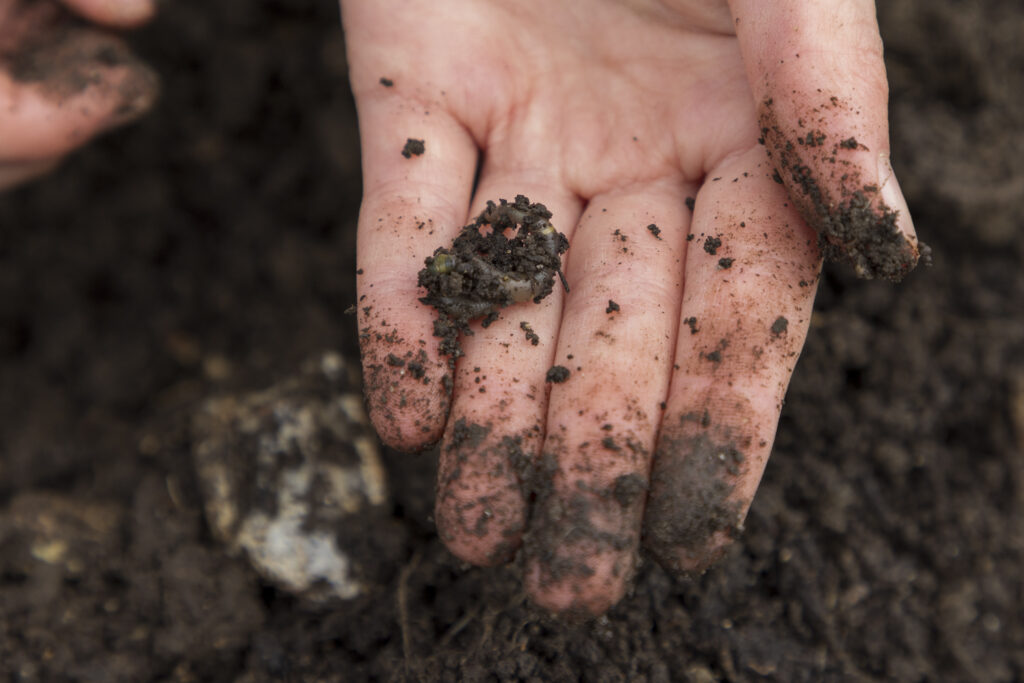
In early February and March 2018, Dr Jackie Stroud, a Natural Environment Research Council Soil Security Fellow at Rothamsted Research, led a project to study the worms in farm soils. 126 farmers took part. They dug 10 pits in one field, each 20 cm x 20 cm x 20 cm, in one field. They counted the number of adult worms in the sample (adults are identified as those having a saddle on their bodies) and allocated them to one of three main types of earthworm. Each of these worm groups has a different function.

  • Epigeic surface worms (the small, surface, red ones) break down surface litter and are a good source of food for native birds, such as thrushes and blackbirds.
  • Endogeic topsoil worms (the medium, pale ones which are grey, pink or a darker green) mix soil and mobilise nutrients for plant uptake and so support crop productivity.
  • Anecic, deep-burrowing large worms (larger pencil-sized ones which are heavily pigmented red or black) are the drainage worms which can form vertical burrows of up to 2m deep. These help with water infiltration and deep plant burrowing.

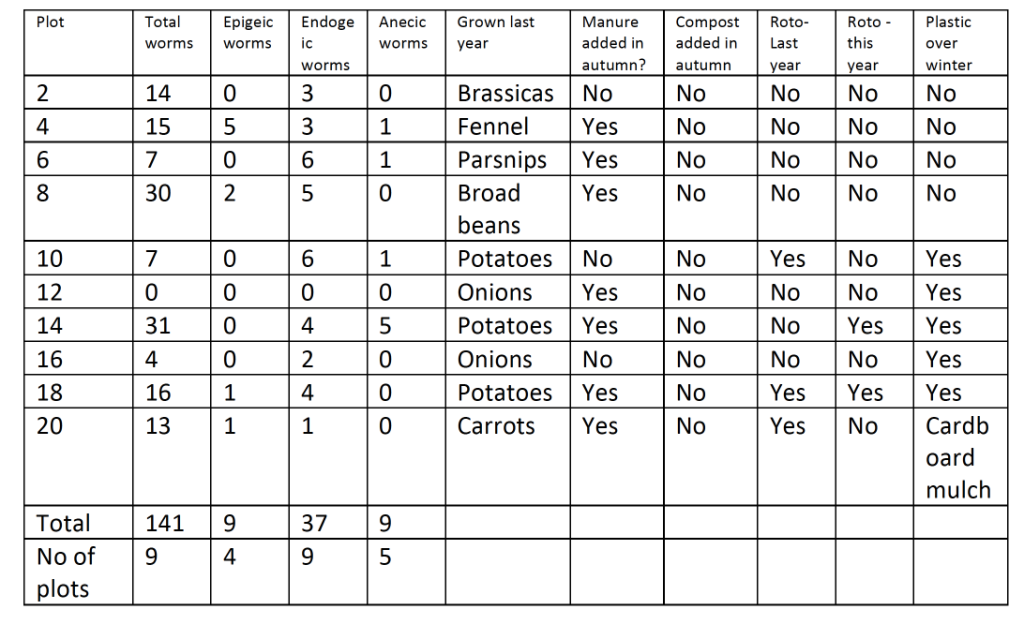
In April 2019, we conducted the same experiment over our ten plots, with a few teams adding a second count. Our results are below and make interesting reading. They are just a snapshot but they give us a baseline for further monitoring and discussion.

Photo: Steve Grundy

Mason bees: no sting in the tail!

You are probably aware of bug hotels with drilled wooden blocks and bee nesting tubes with bamboo bundles or narrow cardboard tubes, but what uses them?

There are several bee species – mason bees (genus Osmia), leaf-cutter bees (genus Megachile) and a few others, but the commonest is the Red Mason Bee (Osmia bicornis) which is active in spring, and is the one that tube manufacturers mention. If you’ve seen the nest tube on the small tool shed recently, it’s been very busy with bees coming and going. It can look like a small swarm but they are solitary (close neighbours rather than a hive) and they don’t sting. So, what are they doing?

Unlike social species like honey bees, each mason bee has its nest in a single tube. The female produces cells in a line, like a tube of sweets, using mud or other materials to build partitions and then seal the entrance. She even has little blunt horns to tamp the mud in place and sometimes you can see the marks these leave when the mud dried. In the absence of artificial nests (preferably south-facing, approx 1-2m above the ground), they use existing holes, and may expand them, including in soft mortar which hasn’t always been popular with householders; however, modern mortar is harder, hence the need for tubes – just like bird boxes. There are a few Osmia species that use empty snail shells instead, sealing up the entrance in just the same way.

Like many insects, they are useful pollinators, especially of fruit trees and can even be bought commercially for this purpose. So, enjoy them, thank them for helping grow fruit, and don’t worry when walking past them, however much they are buzzing about!

If you enjoyed this, read more from Dave Hubble:

Find more from Dave Hubble here: http://davehubbleecology.blogspot.com/