Good health!

By Roberta Beer

For many centuries, it has been traditional for country folk in Britain to light fires, sing songs and drink cider in the orchards on the Twelfth Night after Christmas, to wish the apple trees Good Health and New Year, as well as to each other. This ancient tradition is called wassailing.

Wassail means ” Good Health”. (The response, by the way, to the toast of “Wassail!” is “Drink Hail!” ). There was much merriment and cider drinking on Twelfth Night, as villagers lit fires in the orchards, sang traditional songs, and toasted the trees.

On this day, villagers also anointed with cider their chickens and other animals and brought the village plough into the church to be blessed by the priest. Peasants visited “the big house” to toast the landowner and his family. In return, servants filled the large two-handled “wassail cup” with cider and distributed food to the singers. 

The wassail typically starts with a procession to the orchard, led by a wassail King or Queen. Pieces of toast are placed in the branches to attract robins, which are believed to be guardians of the orchard. The revellers bang pots and pans to wake the tree spirits and to drive away any bad spirits from the land and they enjoy a wassail drink of spiced cider or ale.

Wassailing at HCF

We have three orchards at Highbridge Community Farm and we’ve honoured this ancient tradition of blessing the trees with singing and food and drink. For the wassail, the team nominated one tree in each of our orchards to represent The Green Man, to bring fertility and good harvests to the whole Farm.

Photo: Highbridge Community Farm

Beating the bounds

This is another ancient custom. When maps were rare, a community would periodically walk around its boundaries, beating the boundary markers with a pole as a way of maintaining the memory of the location of these boundaries. We combine this into our wassail ceremony by walking around our three orchards, “beating” the trees with a bean pole.

Wassail songs

Here are a couple of the traditional songs for the wassail. The first is more general for the celebration. The second is specifically for the apple trees.

Here we come a-wassailing

Here we come a-wassailing, among the trees so green.
Here we come a-wandering so fair to be seen.

Chorus
Love and joy come to you
And to your Wassail too.
And God bless you and send you a Happy New Year,
And God send you a Happy New Year.


We are not daily beggars that beg from door to door,
But we are your neighbours children, whom you have seen before.

Chorus

Good Master and good mistress too, às you sit beside the fire,
Pray think of us poor children, who wander in the mire.

Chorus

Bring us a table and spread it with a cloth.
Bring us out, some mouldy cheese and some of your Christmas Loaf.

Chorus

God Bless the Master of this house likewise his mistress too
And all the little children that round the table go.

Chorus

Apple tree wassail

Old apple tree, we wassail thee
Hoping that thou will bear
For the Lord know where we shall be
To be merry another year

Chorus
For to bloom well and to bear well
And merrily shall we be.
Let everyone drink up their glass
And health to the apple tree
For to bloom well and to bear well
And merrily shall we be.
Let everyone one drink up their glass
And health to the apple trees, brave boys
Here’s health to the apple tree

Oh, apple tree, we Wassail thee,
Hoping thou wilt bear
Hatfuls, cap-fuls, three bushel bag-fulls
Many more under the stairs.

Chorus
Meet our artist

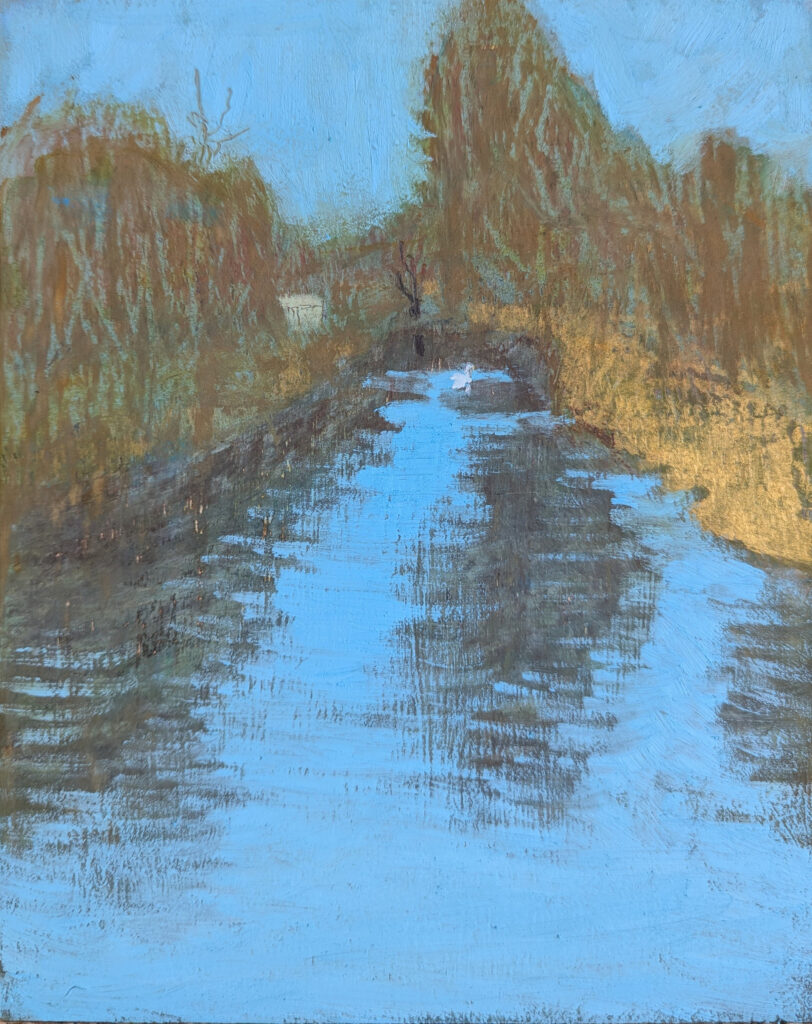
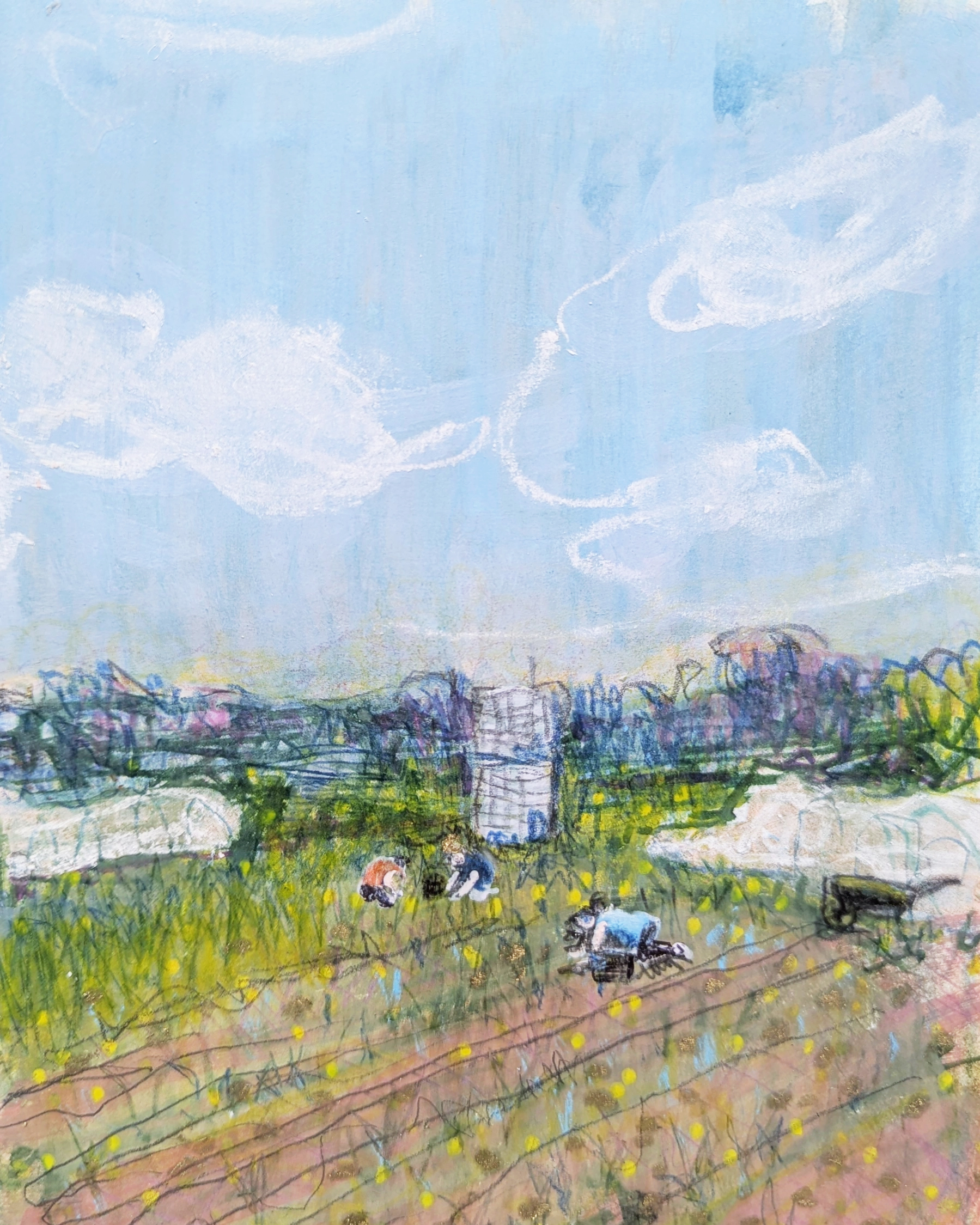
If you’ve wandered past Plots 3 and 4 recently, you might have noticed someone with a camera in hand, quietly observing or capturing the gentle ebb and flow of life on Highbridge Community Farm. That’s me – Jo Rose. I’m a full-time artist based in Winchester, where I work from my studio on Jewry Street.

Photo: Jo Rose

Rooted in the natural world

My artistic practice is is deeply rooted in the natural world. I paint and illustrate abstract impressionist landscapes using oils and mixed media, drawing inspiration from the beauty of the New Forest and the River Itchen. My work often features the wildlife I encounter on my walks and I’m especially inspired by the shifting colours and textures of the seasons, and the changing light on the river.

Photo: Jo Rose

This year is shaping up to be both busy and exciting. I’m currently preparing for several exhibitions, starting with a group show with the Artful Collective at the beautiful Hillier Gardens this July. In August, I’ll be exhibiting a solo collection in Falmouth, and in October, I’m curating an immersive group show in Winchester city centre, all inspired by nature.

My Highbridge project

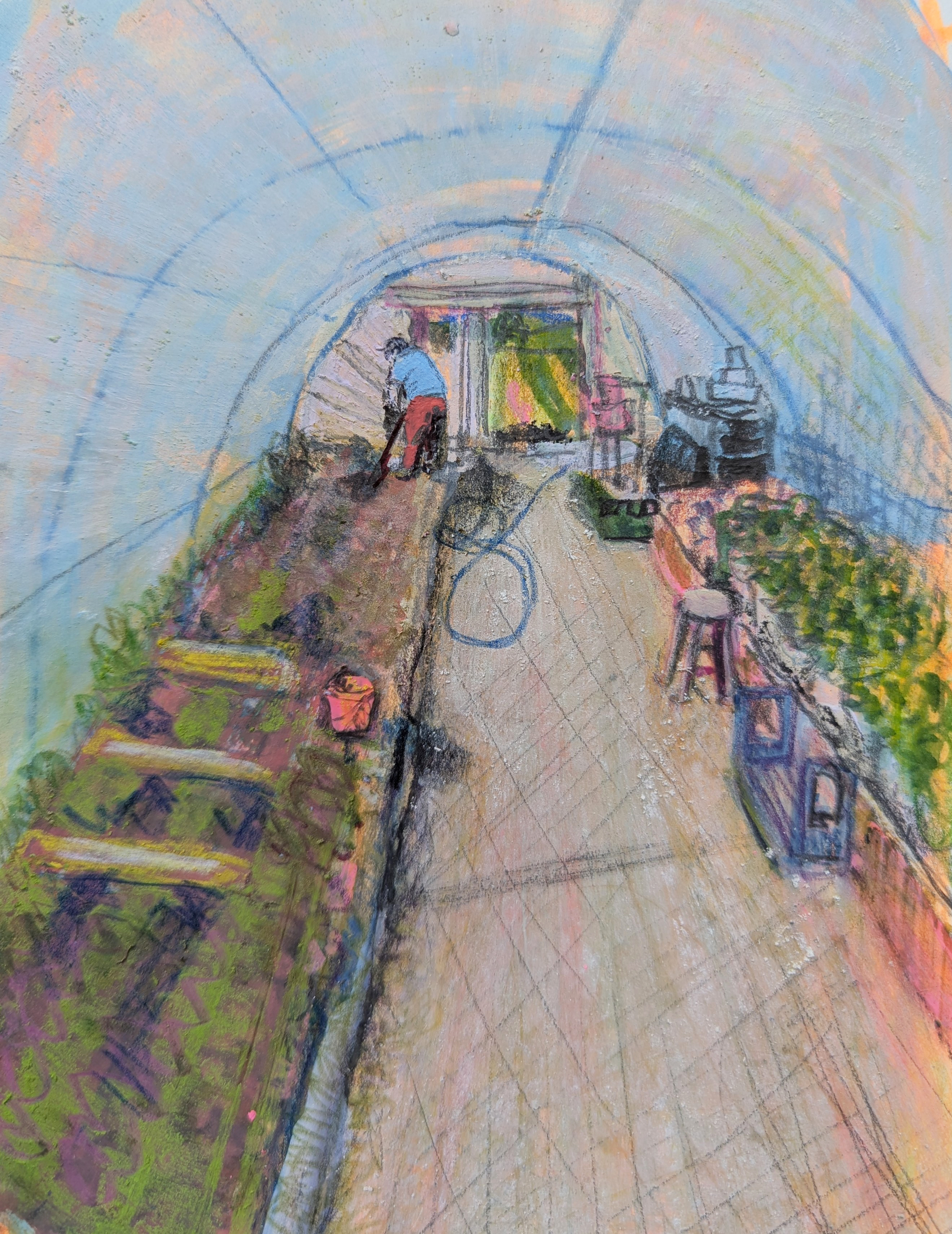
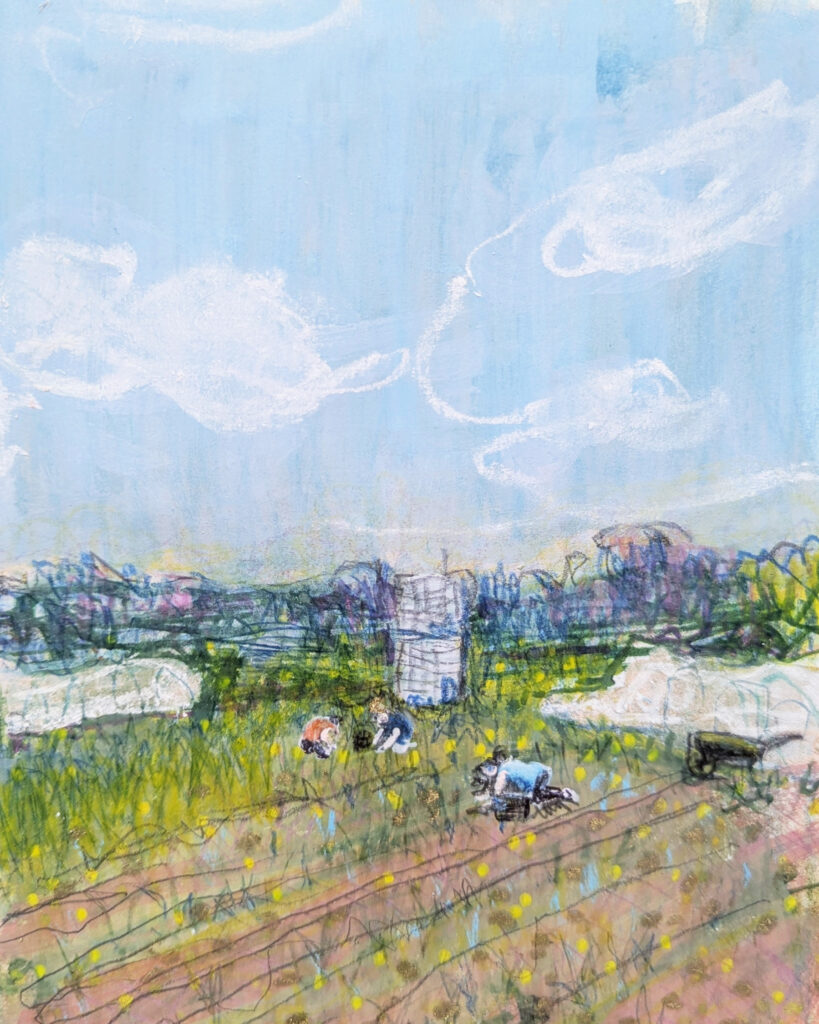
Amid all this, I’m embarking on a personal project: a sketchbook series that documents my time here at Highbridge Community Farm. The photographs I take often evolve into illustrated journal entries—more than just drawings, they become a visual diary of our shared work, quiet moments of connection, and the stories that make this place so special. This project is also pushing me out of my comfort zone as I begin to illustrate people more often, helping me to expand and develop my practice in new directions.

Photo: Jo Rose

Having been a member of the farm for many years, I’ve come to see it as much more than just a place to grow fruit and vegetables. It has offered me friendship, peace, and a sense of grounding through difficult times. The Farm is a wonderfully inspiring community—one that nurtures both the land and the people who care for it. My sketchbooks aim to celebrate this spirit: the collaboration, the care, and the joy that comes from growing together.

If you and your team are working on something interesting and wouldn’t mind being photographed, I’d love to hear from you. This is a collaborative journal, and I’d be delighted to include more of our collective story. And if you’re curious about my work, feel free to stop by Plots 3 and 4 for a chat.

You can find out more about my work at www.jorosestudio.co.uk or on Instagram @jo_rose_studio.

Photo: Jo Rose

Digging into the earthworm survey

Earthworms are key indicators of soil health and ecosystem function so we’ve been checking on the numbers of earthworms in our soil at HCF for several years now. What have our surveys revealed? Andrew Ross explains.

Earthworm sampling is valuable at Highbridge Community Farm because earthworms are key indicators of soil health and ecosystem function. Their presence and diversity reflects soil fertility and the overall health of the ecosystem.

Earthworm activity, including their burrowing and castings, improves soil structure, aeration, and water infiltration, all of which are crucial for plant growth and overall soil fertility. The earthworms helps to create and maintain soil structure, which is essential for healthy root growth and water retention. 

Earthworm sampling is one of a few ways we monitor the health of our soil. We also have a nutrient analysis conducted every two years or so, which tells us the levels of organic matter.

Three types of worm

We identify three types of worms, described below, and juveniles which have not yet developed a saddle. To find out more about how we take the sample, see one of our previous blogs, Worming our way into soil health.

Epigeic worms (surface worms) 

  • These worms live in the leaf litter at the surface.
  • Dark, red-headed worms. They are of small size (less than 8cm).
  • Often fast-moving (good for escaping from birds and most likely to escape from the worm pot!)
  • Sensitive to: digging (which is detrimental) and a lack of organic matter on the surface. They are prey for native birds.

Endogeic (topsoil earthworms)  

  • Pale-coloured and green worms (not red)
  • Small to medium size 
  • Often curl up when handled. These are the most common earthworm group in our plots.
  • Sensitive to: Increased organic matter (beneficial) 
  • Roles: Nutrient mobilisation for plants

Anecic  (deep burrowing earthworms) 

  • Milky-coloured worms, with increasing red or black pigmentation towards the head. 
  • Large size (over 8 cm), typically similar size to a pencil. Make deep vertical tunnels, up to 2m. 
  • Often found below surface earthworm casts or midden residue piles. Feed at night, foraging the soil surface around their burrow for litter.
  • Often absent from ploughed fields (ploughing destroys their burrows) and where there is no surface litter.
  • Roles: Deep burrows that improve aeration, water infiltration and root development. 

A traffic light system to assess the results

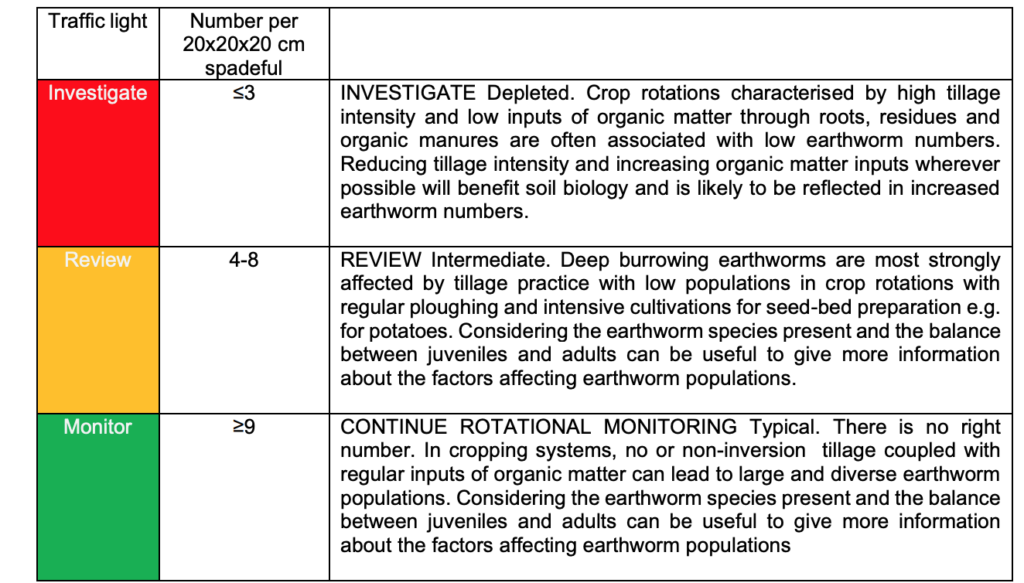
A traffic light system to give an indication of the results has been developed by the Agriculture and Horticulture Development board (AHDB) for the sampling technique that we have used.

Comparing results over time

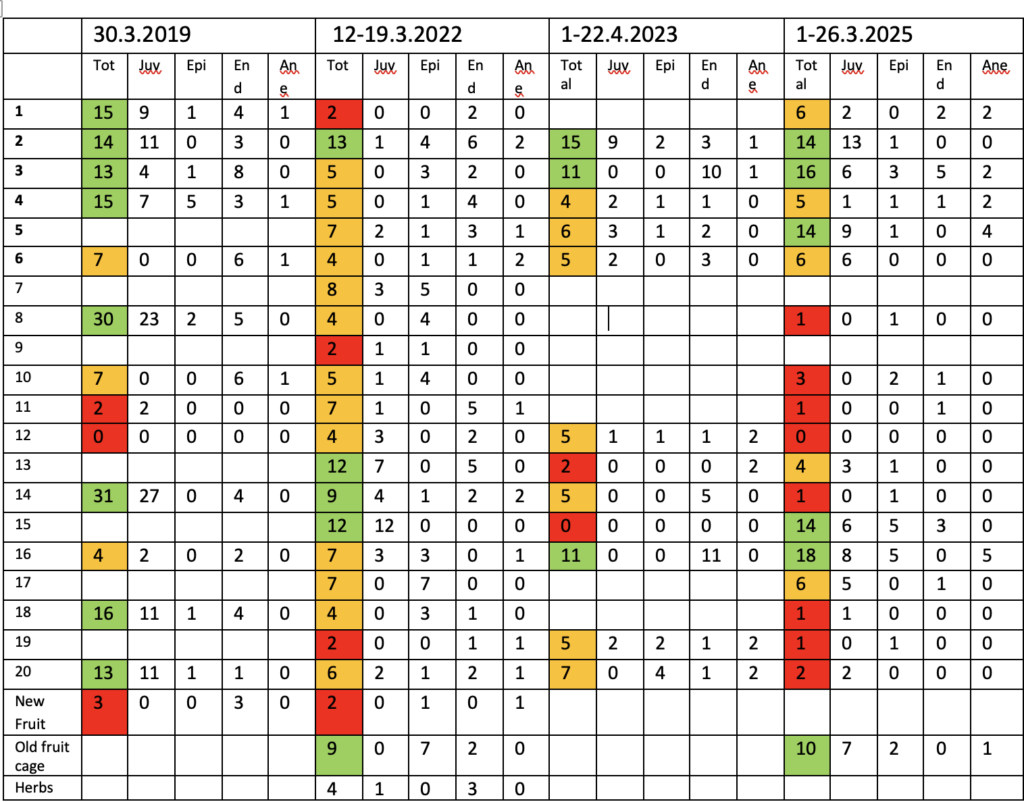
We have been counting the numbers of earthworms on our plots since 2019 to gain an impression of soil health. This table compares the results from March 2019, March 2022, April 2023, and March 2024 compared, with the plots on the left. The colours in the first column of the data come from the Agriculture and Horticulture Development Board’s traffic light system.

The 2025 results suggest that there are a surprising number of plots where the sample revealed very low numbers of worms (identified by the red or orange boxes).

Other plots (identified in green) seem to be doing well with several plots recording worm counts of 14-18 worms per sample.

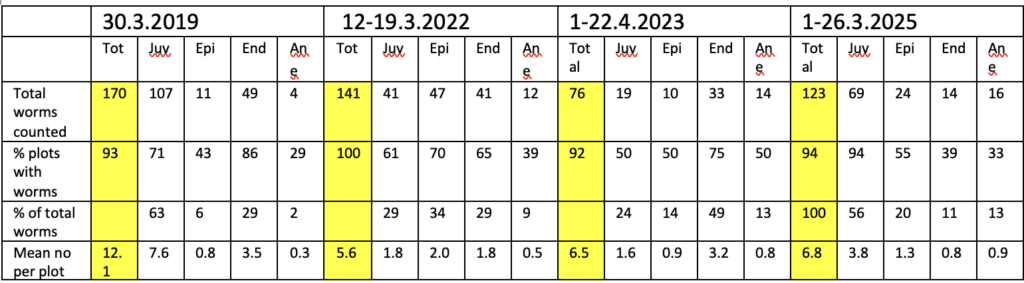
Summary of results across the Farm

What do the results suggest? 

Estimates of the total numbers of worms went down from 2019 until 2022 but they have been rising slowly since. We are not sure why. Is it changes in the weather? Or changes in the soil? Or have numbers been affected by more moles moving into the site? (Moles only move into rich areas of soil which is an encouraging sign of soil quality.) However, an ecological principle is that predators (the moles) do not determine the population size of the prey (the worms) so the presence of moles is unlikely to be the cause of the decline in worm numbers.

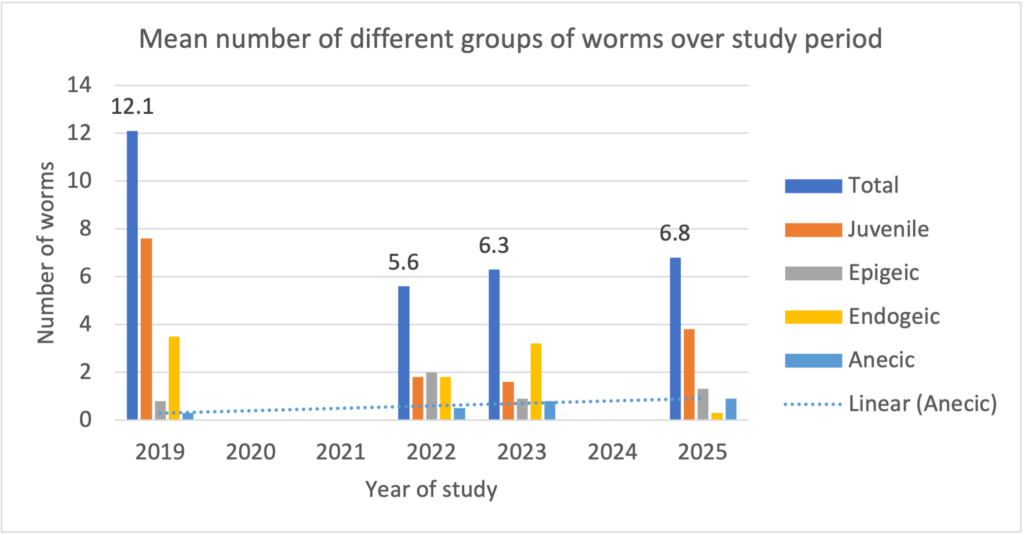
As you can see from the graph below, there have been changes in the percentages of each of the three types of worms and the percentage of juvenile worms, but because of the relative inexperience of some people undertaking the identification, there are likely to be a significant proportion of worm misidentifications.  It is good to see a small rise in average numbers of epigeic worms per plot, which suggests that more organic matter is being left on the surface for these worms to hide in and feed on. It is also good to see a small rise in average numbers of anecic worms per plot and this may be because an increasing number of plots are adopting a “no-dig” approach and so their burrows are not being damaged by digging and remain intact. It is disappointing to see a decline in the numbers of endogeic worms.

We still cannot account for the very low total worm numbers on certain plots. In future years, we suggest that plots with very low numbers which bear a red flag are repeat sampled (perhaps by more experienced samplers) to try to determine whether this is a random sampling error or if this is uniform across the plot and the low worm numbers are the result of an unhelpful growing practice.

Earthworm sampling continues to give us valuable insights into the health of the soil that we need for successful crops. Please let Andrew Ross know of any thoughts you have.

HCF goes edimental

Plot 3 at Highbridge Community Farm has a new set of plants: edimentals. What are these? And why are we interested in growing them? Andrew Ross explains.

An edimental plant is a dual purpose plant: edible + ornamental. Some of them are short-lived perennials so they keep coming up year after year.  We hope that growing edimentals might reduce the amount of labour that we need to grow a crop and, at the same time, increase the visual attractiveness of the plots. 

It’s not just us showing interest in these plants. Garden designer Harry Holding created a whole show garden at Chelsea 20023 based around edimentals. He explains the concept like this: “Edimentals are in the sweet spot of plants that both look nice, are edible, and generally live for three years or longer (ie they are perennial). Traditional food growing is more of a seasonal annual cycle, but with edimentals, once you’ve planted it or sown seeds, they are resilient and have longevity.”

Getting started

We began the project in spring 2024 by planting several different species at the “Roman Road” end of Plot 3. The only one which was eaten by a number of Farm members last year was the purple-leaved tree spinach Chenopodium giganteum. We had high hopes for the Caucasian Spinach, Hablitsia tamnoides, but it was not able to cope with the bright sunlight and sadly, it died. We will try growing it again this year in more shade. It’s a great perennial leaf vegetable.

This year’s plants

We managed to collect seed from two single specimens of red flowered Love-lies-bleeding Amaranth varieties,  Amaranthus caudatus and A. cruentos, that were grown in the plot last year as well as the seeds of several Tree Spinach plants. We’ve drift-sown these seeds in the edimental garden during March 2025. We have also already managed to plant a small area with seedlings of the Orache Atriplex hortensis, whose red leaves will work well cooked or make a great addition to a salad or cooked.    

Four other plants survived last year’s winter: sea kale Crambe maritima, the cabbage thistle Cirsum oleraceum, Korean Celery Dystaenia takesimana and borage Borago officinalis. The borage died back but has returned this spring. The Korean Celery stood strong through the winter cold and should bush up this year.

This year, we’re also putting in new plants, including cuttings of a very old variety of kale called Taunton Dene and another whose thick straight stem earned it the name of Jersey Walking Stick Kale. We’ve sown seeds of the legume Pigeon peas Cajanus cajan and the Siberian pea tree Caragena arborescens and we are waiting to see if they come up. 

We plan to try to grow some of our interesting onion varieties in pots before we plant them out because they were rather swamped by weeds last year. Perhaps the most exciting of these is the Sicilian honey garlic, Allium siculum, which has attractive, pendulous mauve flowers.

Find out more

The edimentals look good on Plot 3 but they also give us a chance to learn about growing different plants and to include plants in our food that we can’t buy commercially. If you’d like to know more about our edimentals, find Andrew Ross at the Farm – and do let us know what you think about this new growing venture.

Turning around our soil problems


You might think that loading your soil with compost, manure, or woodchip can only be a good thing, enriching it and adding to its ability to nourish crops? We thought the same – until Dr Andrew Ross took a closer look at our soil. It turns out that we’ve got a problem. Our soil has too much phosphorus and rapidly declining levels of potassium.

How did we get here? And, more importantly, what do we do next? Andrew Ross takes up the story.

Improving water retention with organic matter

When we were offered the Highbridge Community Farm field way back in February 2010, I took samples of the soil and analysed them in the College lab where I taught. They had between 4-6% organic matter in them. This was a fairly good level that held lots of nutrients for the plants.

But over the next few years, as we came across droughts and water shortages, we realised that more organic matter in the soil would act like a sponge and hold more water. So we chucked on the manure and compost and woodchip and our local council’s recycled green waste called Progrow. The organic matter level rose to 13% and we just about doubled the water holding capacity of the soil (about 90 litres per square metre in the top 30 cm when the soil is at capacity). 

Then came the first problem. Lots of swedes and turnips died. It turned out that the Progrow had raised the pH of the soil to 7.5-8. At that high pH level, the plants couldn’t absorb boron and they died of a shortage. We’ve managed to get the pH down to 6.9-7.2 and everything grew well again.

The phosphorus problem

In 2019, we decided to have some professional soil tests done. Since 2019, we have had the soil analysed every two years and plan to repeat the analysis in October this year. You can read about these analyses in a previous article here.

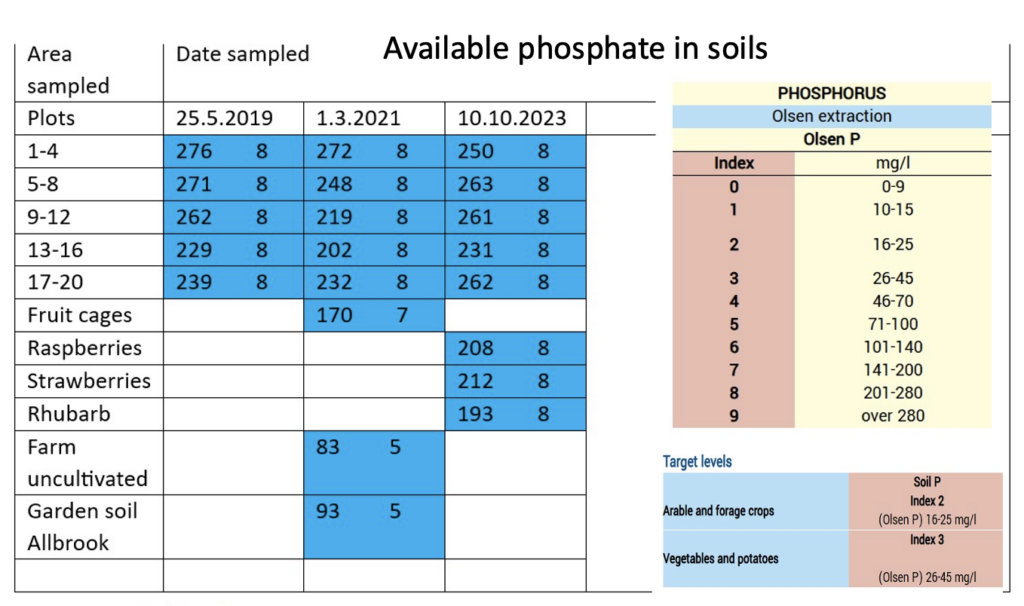
These soil tests revealed level 8 phosphorus. The scale goes up only to 9 and the target level for growing vegetables is level 3 so you can tell that we had a problem.

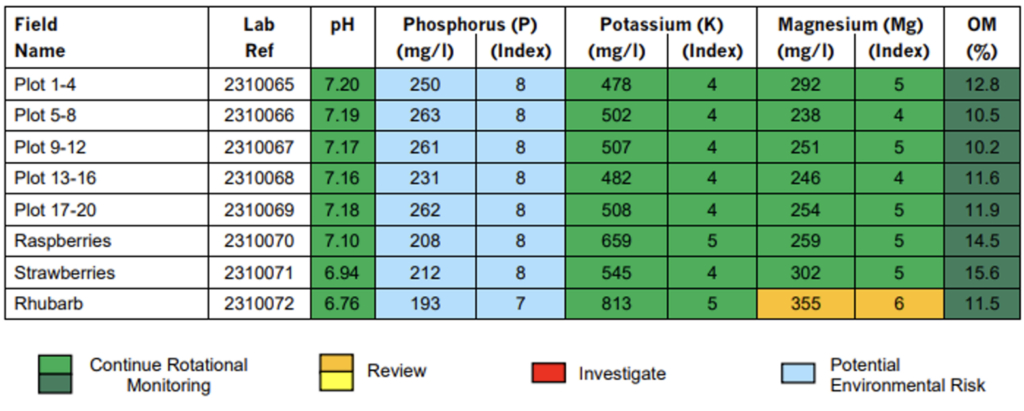
Figure 1. The latest set of soil test results (October 2024)

Figure 2 summarises the phosphate results for each set of tests. Plants don’t require lots of phosphate and, very often, fertilisers can contain a lot more phosphate than they need. Over the last five years, our plants have taken up some phosphate but not sufficiently to lower the levels in the soil. This is because of small additions of manure, compost or woodchip which seem to keep the phosphate level more or less steady.

Figure 2. The 3 sets of phosphate results in mg/l

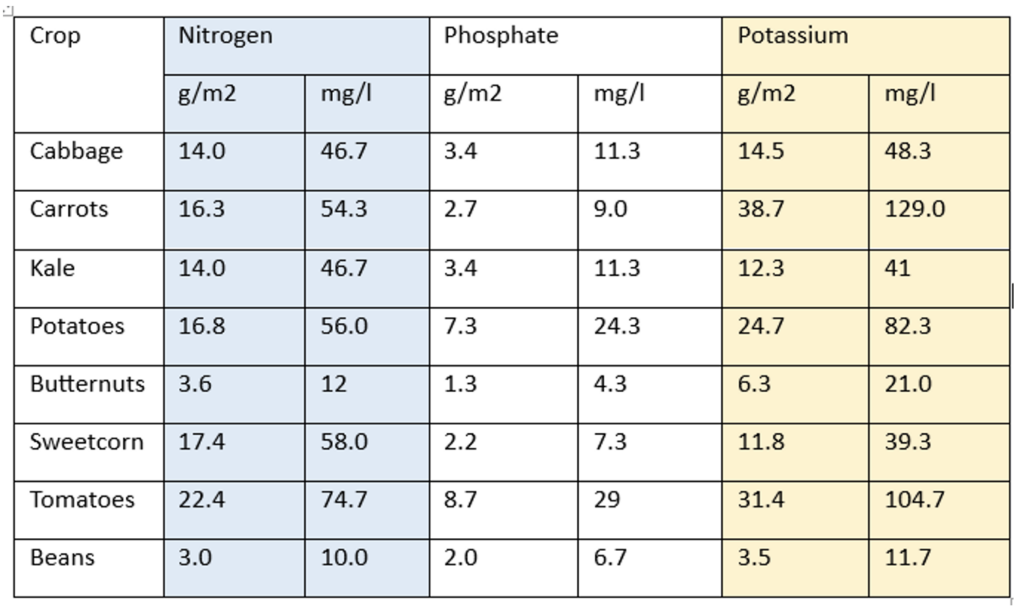
When crops like potatoes and tomatoes grow, they take up quite large quantities of phosphate as Figure 3 shows, but most of the other crops take up relatively little. If we keep adding materials to the soil, the phosphate level could rise further into the danger level of 9.

Figure 3. Nutrient removal by selected vegetables (adapted from New England Vegetable Management guide) in g per square metre of plot or mg per litre of soil.

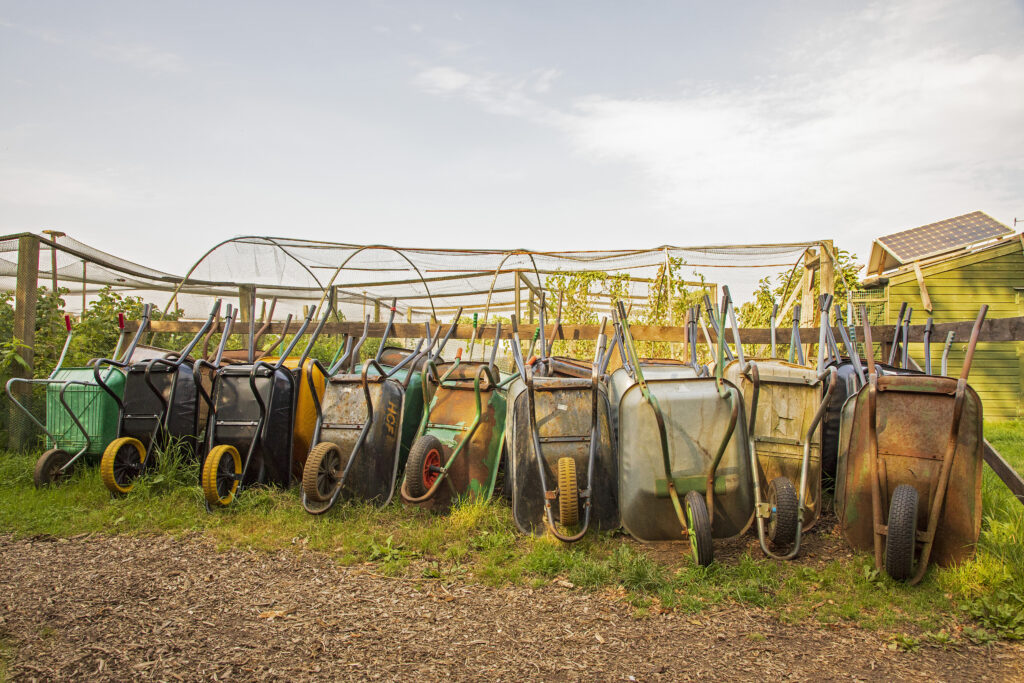
Just four barrow loads more of compost

Photo: HCF wheelbarrows (Steve Grundy)

We have now worked out that if we added 4 barrow loads of compost (weighing 100 kg dry weight and containing 1% Nitrogen (N), 1% Phosphorus (P), 1% Potassium (K), which is typical of compost), then that load would contain 1 kg each of nitrogen and phosphorus and potassium. Spreading that over 200 m2 of a plot and mixing it with the soil to a depth of 30 cm will add 5g of each nutrient per sq m or 16.67 mg per litre of soil.

So putting just 4 barrow loads of compost could raise the phosphate level by 16.67 mg. If that had been done over plots 5-8 in October 2023, that would have raised their phosphate level to 279.7 which is dangerously close to the threshold of level 9 which is 280! And that is why we are trying to add as little compost or manure or woodchip to our plots as possible at this time.  

We know that if the phosphate concentration rises to level 9, plants can show calcium deficiency. They show this with browning and dying of new growth at the tips of leaves and roots and a reduced ability to absorb the micronutrients Iron and Zinc. (Iron deficiency in a plant is characterised by strong yellowing of young leaves.) In addition, there can be poor seed- and fruit production and a greater susceptibility to disease. These are not things that we want to happen and why we must continue to aim at reducing soil phosphate.

The potassium issue

We have the opposite issue with potassium. Plants take up lots of potassium from the soil. and some is washed down out of the soil by excessive rainfall, particularly if the soil is not covered with growing plants. Studies indicate that potassium lost by drainage from soil is approximately 0.5 g or 500 mg per square metre for every 100 mm of through drainage. We had 1000 mm of rain at the farm last year. That is one of the reasons why many teams are planting the cover crop Phacelia over the winter period. Phacelia keeps the soil covered and protects it from heavy rains which leech nutrients down, while pulling up washed-down nutrients with their deep roots. 

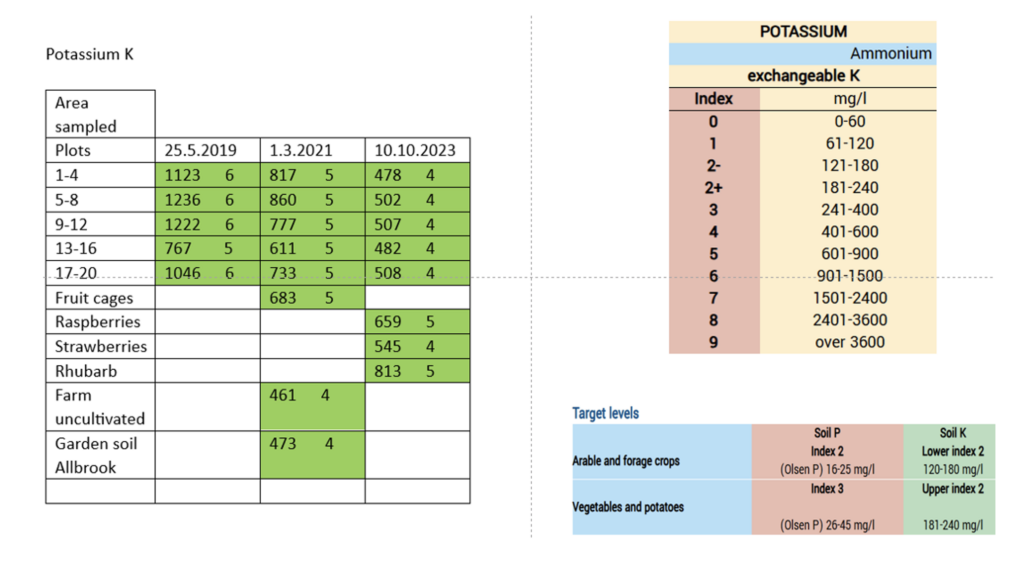
You can see from our results in Figure 5 that the potassium levels have gone down steadily from level 6 to level 5 then to level 4. By October this year, they could be as low as level 2+ which is as low as we would want them to go.

Figure 5. The three sets of potassium results

So, we might need to add potassium to some crops this summer or next year if we begin to see nutrient deficiencies in any of our crops. Plants respond to low potassium levels with leaves turning yellow, especially at the tips, or the margins will crinkle and curl. Then they might go brown and the tissue might die. Plants appear stunted and have poor flowering or fruiting.

Choosing a fertiliser

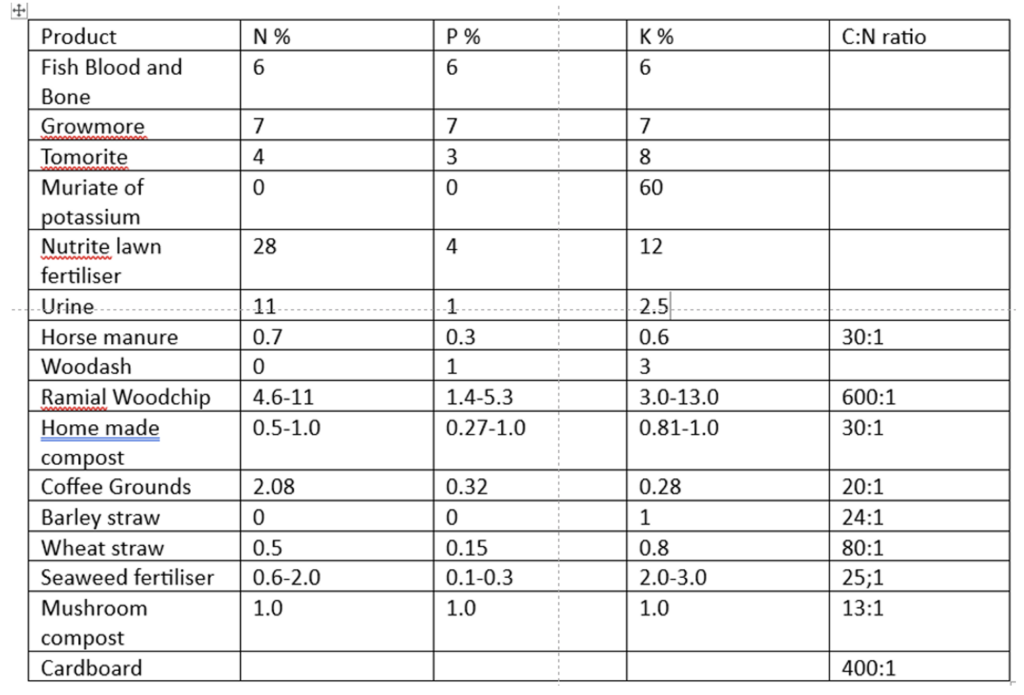
Figure 6. NPK levels in natural fertilisers (taken from a variety of sources)

The best fertiliser on the list is muriate of potash (potassium chloride), while potassium sulphate (0.0.50), potassium magnesium sulphate (0.0.22) and potassium nitrate (13.0.44) have large quantities of potassium.

But are these fertilisers organic? And does that matter? 

Of the other definitely-organic fertilisers in the table, seaweed fertiliser looks to have the greatest quantities of potassium while having low levels of phosphorus, so that may be the best alternative. And that’s a decision for HCF in the future. 

Thanks for reading.

As a community, we’re grateful for Andrew’s commitment to the science behind growing. The chemical analysis of our soil allows us to understand what’s happening in it and to explain the consequences for our plants. We can change the recommendations for the growing teams to give our soil the best chance to thrive. Ongoing testing will show whether we’re back on the right track and whether any more adjustments are needed.

Let us know your thoughts and questions.

Some useful references:

Managing our soil

To grow good crops, we need healthy, balanced soil. Andrew Ross writes about our soil tests and how the results from these and our local weather are informing the way that we will manage the plots over the next year or two.

Three sets of analyses

Over the past five growing seasons, we have had 3 sets of soil analysis:  April 2019, April 2022 and October 2023, whereby 20 small samples from 4 plots (1-4, 5-8 etc) were grouped together and analysed.

What have we discovered?

Organic growers are encouraged to have high levels of organic matter in their soils because it acts as a sponge holding large quantities of nutrients and water. Over the years, we have been piling on the manure, compost and woodchip and so we have raised our organic matter levels to around 12-15%. 

The analyses show that our nutrient levels are high which is generally good, but the big problem has become our soil phosphate level. 

Phosphate levels have stayed stubbornly around 254 mg/l which is way too high and really needs to be reduced to below 100 mg/l. Phosphorus (P) is not directly toxic to plants but, at high levels, it can inhibit the uptake of iron and zinc. This year, we have been seeing raspberries and parsnips showing signs of iron deficiency.

Another feature of high phosphate levels is that, attached to soil particles, they can run off into rivers especially in wet weather and cause eutrophication (excessive richness of nutrients in the water). Phosphates from farming are damaging the rivers like the Itchen that run into the Solent and so both Eastleigh Borough Council and Natural England have phosphate mitigation strategies in place. 

What will we do about the high level of phosphate?

These high levels of phosphate mean that we are going to:

  • Continue with the ban on adding manure to the plots
  • Stop adding woodchip to the plots
  • Continue to make our own seed and potting-on compost so that we don’t bring more phosphate on to the site.

During a growing season, most crops will take up between 13-75 mg/l  of phosphate (which we take away and eat). More will be removed from the plots to the compost bins in crop residues and weeds. But relying on reducing phosphate by this method alone could take several years to achieve healthier levels. In the meantime, other substances will become depleted. So, we will be trying a few other ways as well.

  • Growing winter cover crops such as Phacelia which will add extra organic matter to the soil but not extra phosphorus. 
  • Growing winter crops like leeks and kale which will remove more phosphorus.
  • Growing the nitrogen-fixing field beans or winter tares (a green manure) during the winter which, if cut down before the beans develop, will add extra nitrogen and organic matter without adding more phosphorus.
  • Hoping that, over time, some phosphorus will be converted to the more stable form called “rock phosphate” that has a very limited solubility in the soil.

Levels of nitrogen (N), potassium (K) and magnesium (Mg) will inevitably fall so we might have to add to the soil inorganic fertilisers such as ammonium nitrate, urea, potassium sulphate, magnesium sulphate and possibly wood ash (which contains lots of K and Mg but some P (phosphorus) as well) to keep up the levels of other plant nutrients. 

Rainfall and our management of the plots over winter

No-one can have failed to notice the amount of rain we have had this year. The average annual rainfall at Highbridge is 802 mm or 802 litres per square metre. A few days ago, we exceeded this amount for 2023 and the cumulative total is already nearing 850 mm. And we still have the normally-wet months of November and December to go!

While this reduces the amount of watering that we have had to do, it can make life difficult too. Root crops like potatoes, carrots and parsnips are more difficult to dig. The soil can become compacted by our trampling on it. Crops go mouldy quicker.

If we get lots more rain this winter on our sodden, waterlogged soil, nutrients can run off the surface or be leached down through the ground.

Minimising run off

To minimise this, all teams are being encouraged to grow plants over the winter on all plots. The plants will help to intercept the rain, reduce surface compaction and runoff and pull back up into the plant roots the nutrients that could otherwise be leached. 

More ways to enrich our soil

As well as our winter crops like kales, leeks and parsnips, several teams have been planting the green manure called Phacelia. In the Spring, if we don’t have any severe frosts that kill it, the Phacelia can be cut off, chopped up on the soil surface and left to the worms to pull the decaying bits into the soil. This adds organic matter to the soil.

Other teams who will be planting potatoes next Spring have been planting “spud mix”  – a  mixture of mustard and radish.  Next Spring, the mustard and radish can be dug up and immediately turned straight into the ground. This releases a chemical which kills the wireworms that would otherwise make holes in potatoes. 

It is now getting too late to plant Phacelia, but we are hoping that the weather will be kind to us and give us a window of a few weeks. This will allow teams that missed the Phacelia sowing an opportunity to plant field beans or winter tares. These have the additional benefit of being nitrogen fixers as well as soil cover crops. 

Soil testing has given us valuable insights into the state of our soil and the opportunity to rebalance in a natural way. We’re also doing all we can to mitigate the effects of recent heavy rainfall. What do you do to keep your soil as healthy as possible?

Weather, watering and crops – using water wisely

Andrew Ross explains how much water our crops need in warm weather – possibly much more than you thought!

Water meters help us to discover the condition of the soil and new solar-charged irrigation is taking some of the load – but we still depend heavily on stakeholders with watering cans!

The irrigation project

Mike Lucas has recently completed Phase 1 of our irrigation project. It is all run on solar energy and draws water from the pond. A panel collects the sun’s energy which is stored in a battery for night use or cloudy day use. One of our pumps is capable of pumping 200 cu m of water per month into our IBCs at a slow but steady rate. The other pump feeds the standpipes situated along the Roman Road. Hopefully, gone are the days of using a petrol burning engine and lugging heavy and leaky standpipes (although they remain in reserve).

Mike will be beginning some experimental work on Phase 2 this summer, using timers attached to the IBCs and drip feeds to small areas of appropriate crops.

Rainfall, evapotranspiration, and watering

We are now entering the time of year when evaporation from the surface of the soil and from plants generally exceeds the rainfall and so we need to make up the difference with irrigation. (1 mm of rain is equal to 1 litre of rainfall or watering on a square metre).  

Last week at Highbridge Community Farm, around 25 litres of water evaporated from each square meter of vegetated land!

With normal June weather, we can expect around 92 litres of water to be lost from each square metre over the whole month. If the weather is hot, dry and windy, this might even be more! So, if we should have a dry June, July and August like 2022 with a total of only 60 mm rain, we will have to do a lot of watering. Our watering cans hold 10 litres.  If no rain falls in June, each square metre of actively growing plants will need around 9 or 10 watering cans of water over the month – that is 2 or 3 cans of water per square metre per week.    

We have added a lot of organic matter to our soil which acts like a sponge holding water. The top 30 cm of soil will hold about 90 litres per square metre when at its field capacity. As the soil dries out, plants grow less well and stop growing when the amount of water in the top 30 cm falls to about 60 litres. By the time the soil has only 30 litres of water left in, it most of the plants will have died!

Watering your crops

  • Please do water your crops thoroughly, particularly if little or no rain has fallen. It isn’t sufficient just to wet the surface. You need to see an increase in the moisture levels down to 10 cm and ideally to as far as the roots grow down and to where you find that the soil is already wet.

This is a moisture meter. Use this before and after watering. Holding the metal sensor, push it into the soil to a depth of 5 cm and read the gauge. Push it in about 10 cm and read again. After watering, the readings at 5cm and 10 cm should be at least a MOIST 6 to a WET 8 on your scale.   

  • For most crops (except salads), it is better to water a bed thoroughly with 2 or 3 cans of water per square metre once a week than to sprinkle a can over a whole bed every day as most of that water will not infiltrate more than 2 or 3 cm. This is because deeper roots will not receive any water and a lot of the surface moisture will simply evaporate away very quickly.  
  • Ideally, water in the evening (or early morning) to give plants the opportunity to take up as much water as possible. Water the soil, not the plants. 

Water is a limited resource. Use it wisely!

Growing a new HCF team

Wild Hive Ecological Educational Collective is helping us to grow a new HCF team. Welcome to Green Team@HCF! Wild Hive founder, Jo Hutchison, explains how it works.

Find the story of Wild Hive here and about the Wild Hive outreach projects here.


Photo: Jo Hutchison

After quite a journey to date, Wild Hive is delighted to have come full circle back to Highbridge Community Farm from which our educational outreach initiative originally stemmed.

We’re very excited to have been offered a couple of good sized patches on Jim’s team’s plots – particularly because the children now have their own area right beside their play-hut and pollinator garden – in which to grow their own!  These areas will amply fit all four of our Local Grow Packs, and hopefully leave a little space for other things the children might wish to try.  

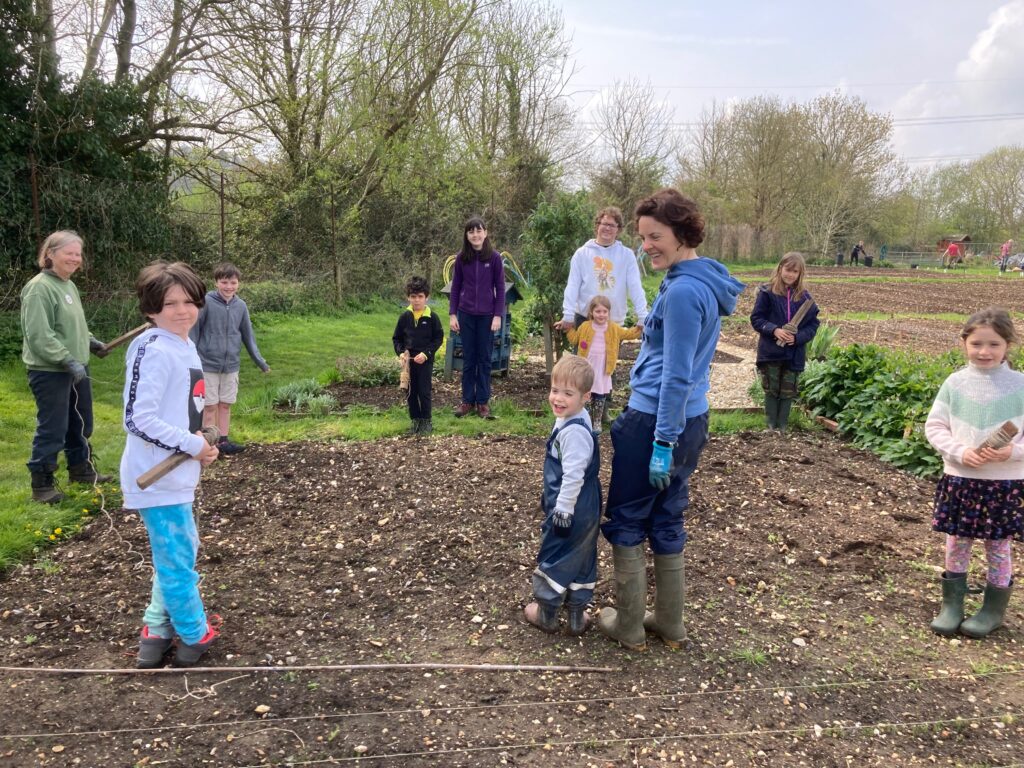
Wild Hive Collective CIC is helping the Green Team @HCF to form, and, whilst trialling the Local Grow Packs, will offer sessions to support and monitor the growing. The idea is that with a little guidance and initial steer, the children will gradually organise themselves, manage their activities, and develop a sense of agency with space of their own in the heart of Highbridge Community Farm.  

Certainly in the initial stages, it will be helpful to have some adult helpers for input and guidance (when wanted!).  If you are a stakeholder and either you or you child(ren) are in joining the Green Team @HCF and/or supporting Wild Hive in any way, please complete this form.

The intention is that Wild Hive Collective CIC will use the sowing, growing & harvesting of the Local Grow Packs as an opportunity to help this team of younger ‘farm-hands’ (currently HCF stakeholder children only) to gather together and to sow, harvest and enjoy meals that they have grown, whilst they naturally become the ecological growers and nature custodians of the future. 

Find out more

Find Wild Hive on Facebook and Instagram. If you’re an HCF stakeholder and you’d like to know more about Green Team@HCF or to get involved, find Jo at the farm or fill in this form.

Worming our way into soil health

Andrew Ross organises regular surveys of earthworms in our soil at Highbridge Community Farm. He explains why we do these surveys and what we learn.

Why we do worm surveys

Having a healthy soil is important if we wish to grow healthy, nutrient rich plants at Highbridge farm and eat healthily ourselves. Worm surveys are one of a few ways we use to monitor the health of our soil. We also have a nutrient analysis conducted every two years or so, which tells us the levels of organic matter (a measure of carbon and nitrogen levels), phosphorus (which is higher than we would wish) and potassium.

The National worm survey

In early February and March 2018, Dr Jackie Stroud, a Natural Environment Research Council Soil Expert at Rothamsted Research, led a project to study the worms in farm soils. A total of 126 farmers took part. We joined the project in 2019 following the national method, and have done a survey annually since, with the exception of last year, when the soil was so dry that there were very few worms in the top 20cm of soil.

How we do the survey

Each team digs a soil pit 20cm x 20cm x 20cm on their plot and removes all the soil to a tray. They then carefully sort through this sample and remove any worms they find into a smaller pot containing a little water (to keep the worm skins moist for breathing). Then we count the total number of  worms in the sample and then divide them into adults and juveniles. Adults are identified as those having a saddle on their bodies which juveniles don’t have. The juveniles are counted and then returned to the soil. The adults are then sorted into one of three groups of worms with different roles in the soil ecosystem before being counted. Then all worms are returned to the soil. 

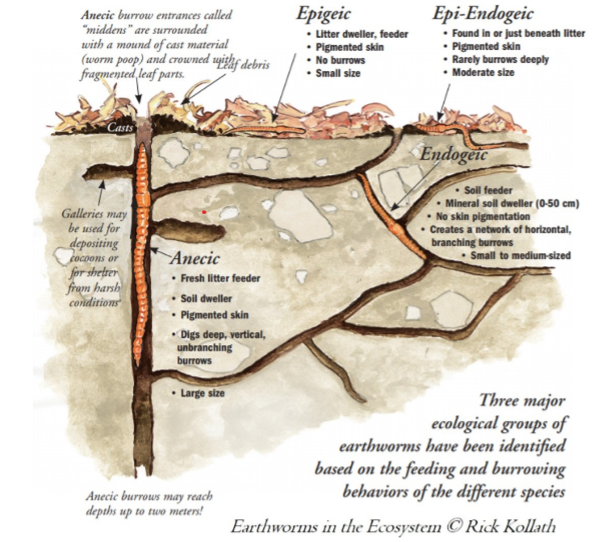
Epigeic worms are small or medium sized darkish red worms that live on or very near the surface of fields with abundant leaf litter and feed on the leaf litter and deposit smaller, broken-down bits in the leaf litter for other organism to feed on, so accelerating the breakdown of leaf litter. 

Endogeic worms are small or medium pale worms which are grey, pink or green or bluish. They make horizontal burrows through the soil to move around and to feed. In doing so, they mix soil and help release nutrients for plant uptake and so help to raise crop productivity.  

Anecic earthworms are the large pencil sized worms which were heavily pigmented red or black . They make permanent vertical burrows in soil. They feed on leaves on the soil surface that they drag into their burrows.  They also make middens (piles of casts) around the entrance to their burrows. The are great for making long vertical holes in the soil which improves drainage and allows more oxygen to get to the plant roots.

Earthworms in the Ecosystem (c) Rick Kollath (all rights reserved), taken from https://www.earthwormsoc.org.uk/earthworm-ecology. Click on the image to visit the illustrator’s website.

Our results 

The table shows the number of adults counted each year in the soil sample taken from the even numbered plot. The figures list the numbers of first epigeic, then endogeic and then anecic worms. 

Plot2019202020212023 – to come
20,3,03,0,1na
45,3,16,2,21,3,1
60,6,10,0,00,0,0
82,5,01,6,1na
100,6,11,0,01,0,0
120,0,01,2,02,2,0
140,4,5na0,0,0
160,2,00,6,10,0,1
181,4,01,0,0na
201,1,00,0,12,0,2

Average per plot 
14.17.147.42
Average juveniles8.64.144.33
Average epigeic0.91.31.3
Average endogeic3.71.20.8
Average anecic0.80.50.9
Number of adult earthworms counted each year in the soil sample

Our results suggest that the numbers of adult worms went down from 2019 to 2020 and 2021. There are two possible explanations for these results. Either our farming practices are harming the soil for worms or changing seasonal weather (drier weather) may cause the endogeic and anecic worms to move lower in the soil. Rainfall for the months of January to March in Allbrook is shown below.

Month20192020202120222023
Jan 291028825148
Feb7416268725
Mar8761185596 (to Mar 27th)
Rainfall for January to March 2023 in Allbrook

This March has been the wettest in 5 years, so we are hoping that our worm numbers will be higher than in the last couple of counts and that worm numbers are more strongly influenced by soil moisture and not by our harmful farming practices!

What the each group of worm results will tell us

Epigeic worms tell us if there is sufficient plant material remaining on or near the surface of the soil for these worms to feed and hide in and thus survive. Intensive cultivation, clearing of crop debris and long periods of bare soil often result in a reduction of these numbers and so less organic matter is made available to soil dwelling organisms and the soil ecosystem begins to break down..

Endogeic worms do a lot of the mixing of the soil and making nutrients available where the roots are growing. These are usually the last group of worms to decline in a soil.

Anecic worms feed on leaf litter at night and pull leaves and organic debris from the surface down into the earth. When the soil is dug their permanent burrows are disrupted and frequent digging often causes a decline in their numbers and a subsequent loss of aeration and drainage channels in the soil. It may be that the teams that practice minimum dig (Teams 1-4) and using green manures (Team 3-4) will have higher numbers of certain types of worms. All this will be revealed by the data we collect. 

For further information, see Mariko White.   What can worms tell us about our soils?  (Hampshire and Isle of wight Wildlife Trust. Published online 31.7.2019).

Community farming Down Under

On a recent trip to New Zealand, Julie and Andrew visited some local community gardens. Read what they found – and how much connects us from one side of the world to another.

Waimarama Community Gardens, Nelson, South Island, New Zealand 

In January – February this year, we took a trip to South Island, New Zealand.  It was a long-held ambition to see this country, but also, we had a standing invite to stay with some old friends, now resident in Nelson, at the northern end of South Island. 

After a few days being shown around the Nelson area, which includes amazing beaches, and several national Parks, most notably Abel Tasman National Park, we were let loose and paid a casual visit to Waimarama Community Gardens, which we had seen signposted in Nelson town.

Photo: Andrew Quayle (HCF)

Established 23 years ago – the gardens were quite a hotchpotch on first sight, set just below the hills above Nelson and at the start of the 175kms-long Great Taste Trail, a food and drink walking/cycling trail, presumably for wobbly cyclists. (One for next time!). The edges of the site were more overgrown, blending into the local vegetation, and a sort of organised chaos reigned.

Photo: Andrew Quayle (HCF)

During our visit to the Nelson area, we were lucky with warm and sunny weather, with lots of birds singing, and cicadas chirruping as soon as the day warmed up. 

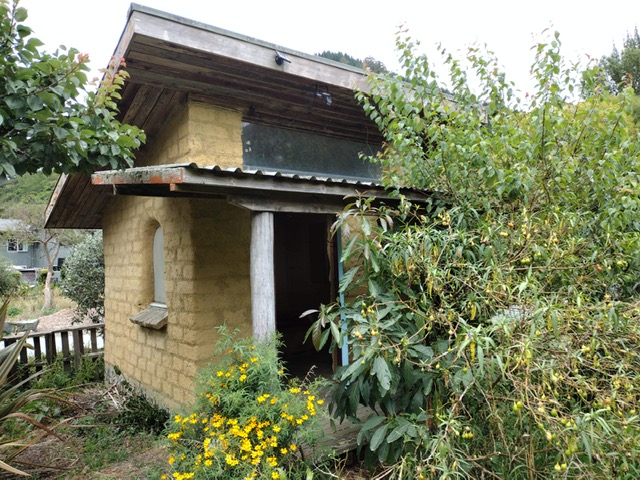
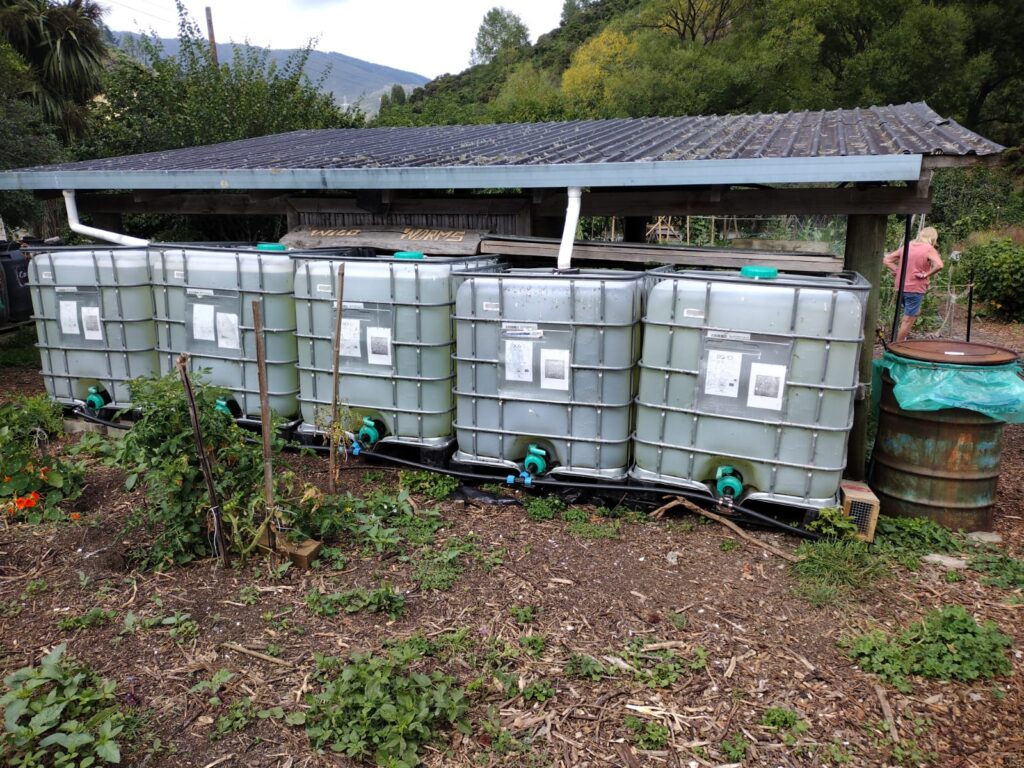
There was a huge amount that was very familiar at Waimarama: various huts and sheds consisting of a seed shed, a sales area, wormery, a posh clay-brick compost toilet (very envious of this!) and community shed; IBCs (yes, they are everywhere) taking rain from shed roofs; a Rota Board of tasks – advising volunteers of Wednesday and Saturday tasks; and numerous individual small plots being tended by plot-holders busily watering.

Photo: Andrew Quayle (HCF)

Seemingly, IBCs are the solution where ever you go. Collecting rainwater for the plants is even more critical in Nelson than the UK because the South Island of New Zealand is in its third year of drought.

Photo: Andrew Quayle (HCF)

Although we had turned up unannounced, we were lucky to be pointed in the direction of Sally (family from Somerset originally), who was about to show round a potential new recruit, an amazingly knowledgeable teenage girl who was very keen to learn and hoped to become a regular volunteer. Her family home had only a yard for the dog and no plants.

Sally showed us some experimental Three Sisters Companion Planting which was thriving. If you haven’t heard of this, it seems to be a native American idea starting with sweetcorn, which provides the support for beans twining up the corn stems, with beans providing soil nitrate, surrounded by a ground layer of squash and courgettes suppressing weeds. We only knew of the Three Sisters idea after reading Braiding Sweet Grass, a book by American writer Robin Wall Kimmerer. Wonderful to see being put into practise – would it work in our rather cooler climate?

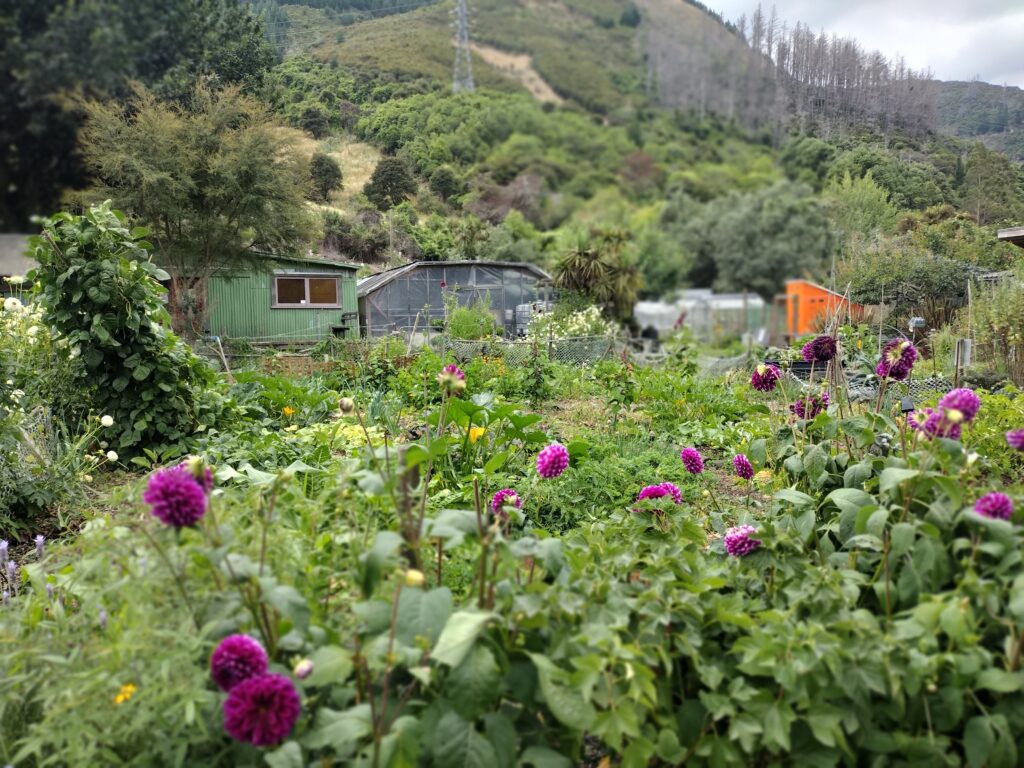
We also loved the individual chaotic plots which didn’t appear too rigidly planned but so good to see in their full summer glory. We were staggered by the flowers (lots of dahlias), herbs and vegetables, having left a cold English January.

Photo: Andrew Quayle (HCF)

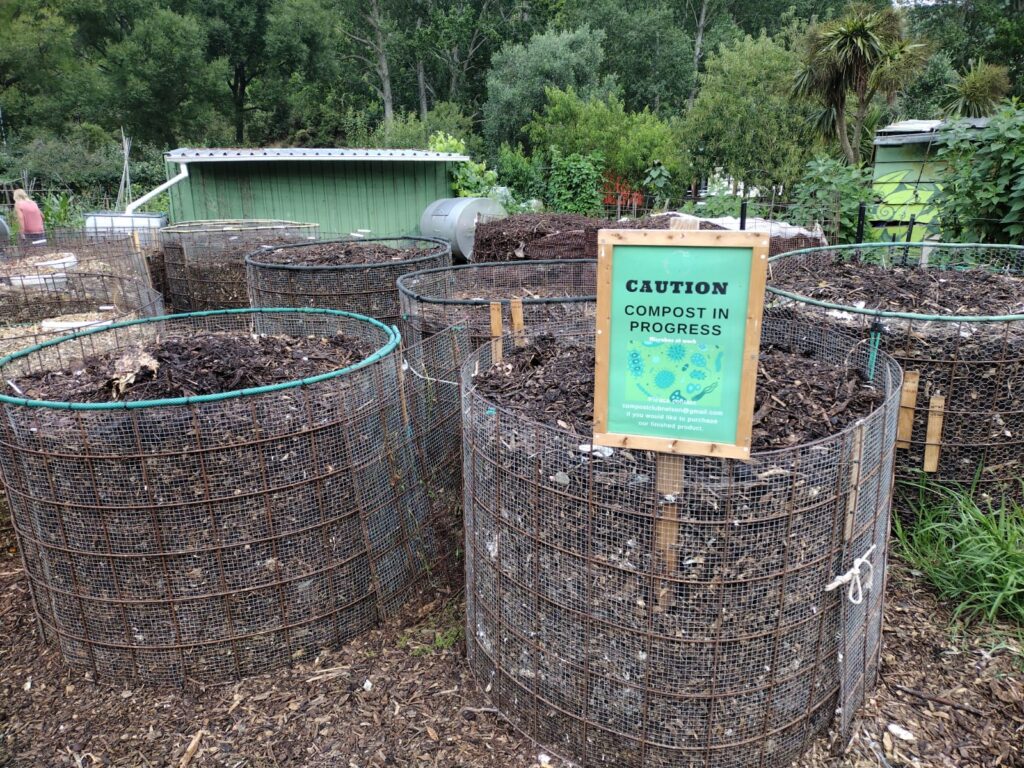
Their Compost Club met on Saturdays and were making so much compost they had spread some surplus on adjacent waste ground and were growing squash.

Photo: Andrew Quayle (HCF)

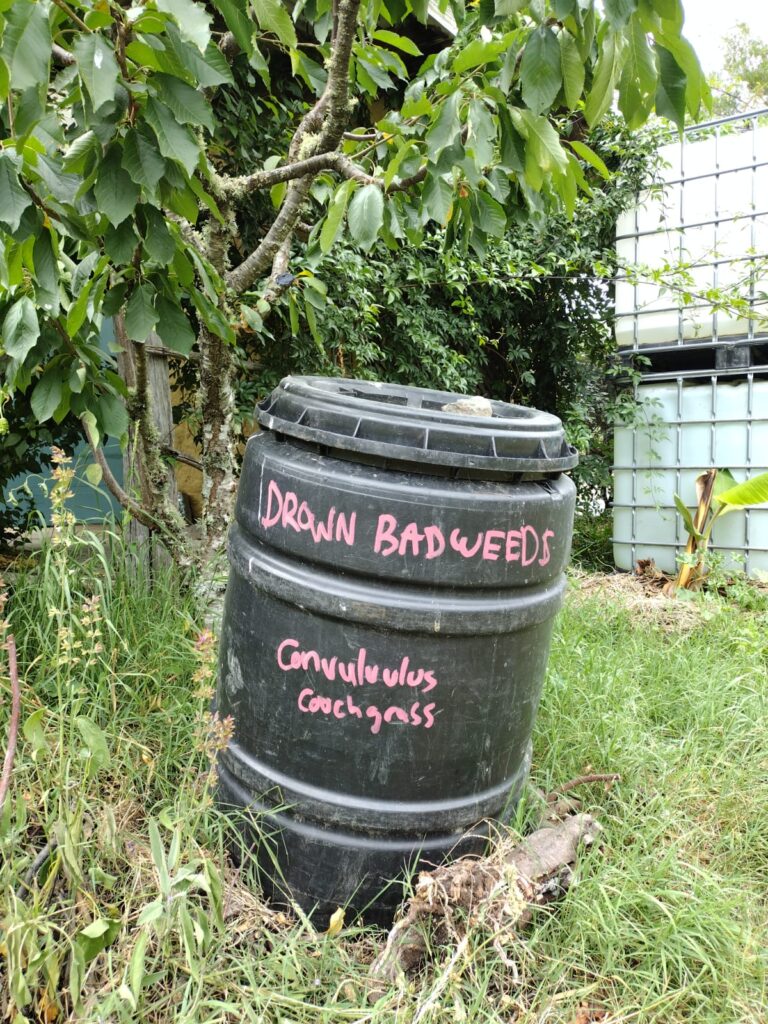
Drowning pernicious weeds seems universal. Unfortunately, the worst weeds in New Zealand all seem to be from the UK!

Photo: Andrew Quayle (HCF)

We took their Facebook details and took our hasty leave of the community garden as the sandflies started to find us.

(Incidentally, a great Saturday event in Nelson is the Farmers market – stalls full of blueberries, raspberries and lots of produce grown nearby by small producers.)

Have you visited community growers elsewhere? Let us know what you found.